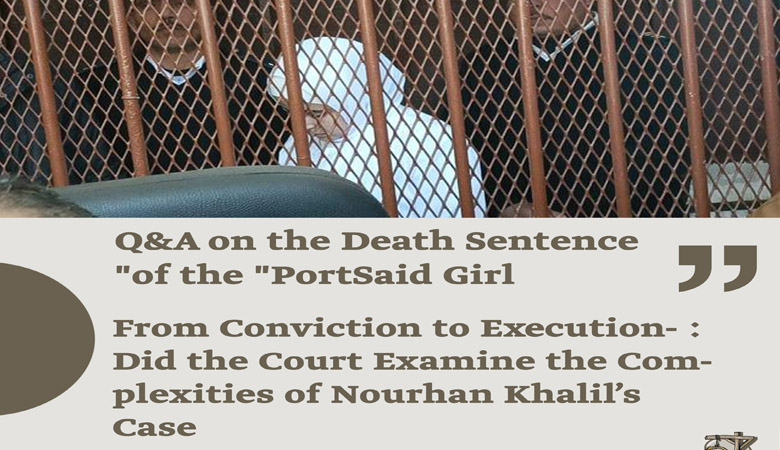
Q&A on the Death Sentence of the “PortSaid Girl”: From Conviction to Execution- Did the Court Examine the Complexities of Nourhan Khalil’s Case?
June 17, 2025
The Egyptian Commission for Rights and Freedoms (ECRF) is deeply concerned by the decision of the Court of Cassation on 19 May 2025 to uphold the death sentence against university student Nourhan Khalil, in the case publicly known as the “Port Said Girl.” The Commission believes that this ruling not only reflects a failure in achieving justice but also reveals a systemic incapacity to grasp the psychological, social, and gender-based dimensions of the case.
In December 2022, Nourhan was charged with killing her mother, allegedly in collaboration with a boy who was no older than 15 at the time. The death sentence was handed down in February 2023 by the Port Said Criminal Court in a remarkably short timeframe, without providing her with access to specialized or gender-sensitive legal defense, and without including any psychological or social reports to contextualize the complexity of the crime.
Although the victim was Nourhan’s mother, the legal guardian (her father and the victim’s husband) formally waived the criminal complaint — a step that, under Egyptian law, grants the court discretionary power to commute the sentence. Nevertheless, the court disregarded this waiver, and the Court of Cassation’s decision has now rendered the death sentence final and irrevocable.
This sequence of proceedings and rulings raises fundamental questions about the court’s understanding of what truly happened — or whether the court merely recounted the incident and issued a sentence. In this context, we raise the following questions:
1. Was any inquiry made into the family environment in which Nourhan was raised?
2. Did the court consider the psychological and age gap between a girl in late adolescence and a child under 15?
3. Did the court interpret this relationship as a sign of psychological vulnerability requiring analysis, rather than a justification for the harshest penalty?
4. Why were no psychological or social reports included in the case file? Did the court find such understanding unnecessary?
5. What kind of legal defense was made available to Nourhan? Was she represented by lawyers with expertise in complex, gender-sensitive cases?
6. Were the circumstances that led to the crime thoroughly examined? What was the position of the presiding judge?
7. Why did the court not exercise its discretionary power to reduce the sentence, especially considering the father’s official waiver?
8. Why are women not treated by the judiciary as complex individuals with motivations and context, as male defendants often are in similar cases?
9. Is justice consistent when a man who burns his sister to death receives a reduced sentence, while a teenage girl who kills her mother is sentenced to death?
10. What ultimately governs court decisions: justice or social norms? The law or gender-based stereotypes?
These questions are pressing considering an irreversible final judgment. Nourhan Khalil’s case is not an isolated incident, but rather a symptom of a deeper crisis in the criminal justice system — particularly in cases involving women.
Accordingly, the Egyptian Commission for Rights and Freedoms calls for:
1. The complete abolition of the death penalty, as a violation of the right to life and a failure to achieve meaningful justice or deterrence.
2. Replacing the death penalty with custodial sentences focused on rehabilitation and social reintegration.
3. The immediate annulment of the death sentence against Nourhan Khalil, and the reopening of her case before a neutral judicial body that guarantees fair trial standards.
4. The integration of psychological, social, and gender-based analysis at all stages of judicial proceedings, rather than relying solely on traditional criminal frameworks.
5. A thorough review of judicial discretion in cases of intra-family homicide, ensuring that it is free from bias or gender-based discrimination.