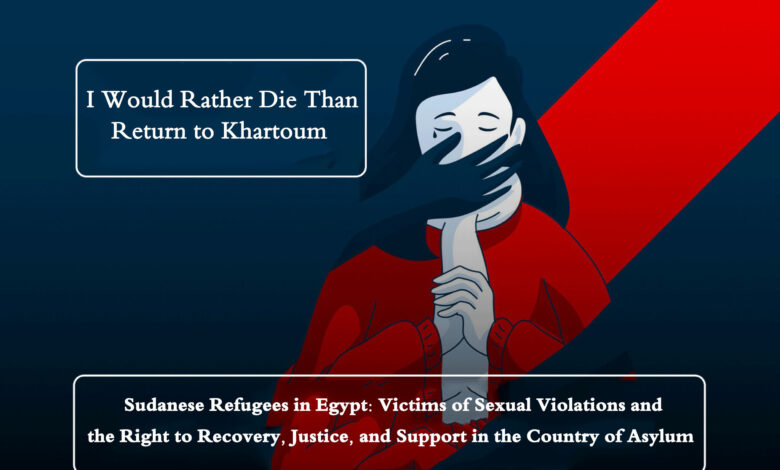
I Would Rather Die Than Return to Khartoum
Sudanese Refugees in Egypt: Victims of Sexual Violations and the Right to Recovery, Justice, and Support in the Country of Asylum
The Egyptian Commission for Rights and Freedoms launches its new report titled:
“I Would Rather Die Than Return to Khartoum: Sudanese Refugees in Egypt as Victims of Sexual Violations and the Right to Recovery, Justice, and Support in the Host State.”
The report documents the suffering of victims of sexual violations among Sudanese refugees and survivors residing in Egypt, based on a documentation process that extended from May 2023 to December 2024, relying on live testimonies, extensive legal analysis, and credible international references.
With the intensification of the war in Sudan, thousands of civilians—women, men, and children—were forced to flee from widespread sexual violations used as a weapon for humiliation and terror. And although Egypt was one of the main destinations of escape, the journey of pain did not end upon crossing the border, as many refugees face a difficult situation characterized by the absence of protection, lack of services, and the risks of detention or deportation despite many of them holding official refugee documents issued by UNHCR.
The report highlights the scale of sexual violations experienced by Sudanese refugees before seeking refuge in Egypt, assesses the humanitarian and psychological situation that requires specialized support, warns against the danger of returning victims to Sudan amid ongoing conflict and widespread violations, and calls for providing support and assistance from the Egyptian host community and international actors, while affirming the possibility of achieving justice under international humanitarian law and ensuring accountability for perpetrators of these crimes.
The report also discusses the so-called “voluntary return journeys” organized by the Egyptian National Railway Authority, which have returned between 20,000 and 30,000 Sudanese so far through 32 trips. Although the government claims these journeys are “voluntary,” the testimonies indicate that most of those who returned were not truly willing to go back, but were driven by poverty, inability to secure food and shelter, threats of detention, or loss of hope in maintaining a dignified life inside Egypt.
The report underscores the danger of such returns for victims of sexual violations, as returning represents a direct threat to their lives—either from warring parties or due to social stigma within their local communities.
The report relies on a multi-source methodology that includes field documentation and direct documentation with victims of violations who arrived in Egypt, where individual interviews were conducted with 20 cases of victims and survivors. Seven of them agreed to publish their testimonies using alternative coded names to protect their identities, while the testimonies of the remaining 13 were used only for analysis due to security or social concerns. The interviews ensured a safe and supportive environment, explicit consent was obtained, and testimonies were reviewed by their owners before approval.
The report also relied on international references and reports, drawing on documents issued by credible international organizations, including Human Rights Watch, Amnesty International, and the Office of the High Commissioner for Human Rights, among others. In addition, the report provides legal analysis by highlighting the international legal framework that criminalizes sexual violations in conflicts, including the Geneva Conventions on the protection of civilians, the Rome Statute of the International Criminal Court, and international jurisprudence on sexual crimes during wars, in addition to presenting and examining the challenges that hinder accountability and the possibilities of achieving justice for victims.
The report consists of three main sections٬ Before refuge, which discusses sexual violations as a weapon in the Sudanese war and presents seven documented testimonies. After refuge, detailing the harsh reality of refugees, including discrimination, lack of protection, legal gaps, and psychological and social impacts. The legal framework of sexual crimes, the responsibility of perpetrators, international experiences in transitional justice, and victims’ aspirations.
Through this report, the Egyptian Commission renews its call for anyone who has been subjected to similar violations to come forward and provide their testimonies. It also calls on both the local and international communities to provide all possible forms of support to these victims, and to respect their humanitarian circumstances and needs in the host country.
The crisis is exacerbated by the delays in issuing refugee cards—sometimes up to one or two years—which deprives thousands of legal status and essential services, leaving them vulnerable to exploitation and daily fear of arrest and detention. Psychosocial support programs have also been affected due to the decline in international funding, and community schools have faced restrictions, closures, and resource shortages, increased the isolation of children and hindering their integration.
To read the report:
I Would Rather Die Than Return to Khartoum
Sudanese Refugees in Egypt: Victims of Sexual Violations
and the Right to Recovery, Justice, and Support in the Country of Asylum
Contents
Introduction
Methodology of the Report
A Brief Overview of the Crisis in Sudan
Section One: Events Prior to Seeking Asylum in Egypt
Sexual Violations as a Criminal Weapon During the War
- Sexual violations in the context of the war in Sudan
- The social and economic context
- “I would rather die than return to Khartoum” — rape of men
- The international community and its role
- The long-term impact on Sudanese society
A Transnational Crime… Shocking Testimonies of Victims
- Testimony One: Children and girls giving birth because of being raped
- Testimony Two: The child who became a mother with no homeland or support
- Testimony Three: Rape and pursuit of victims even in the country of asylum, in the heart of Cairo
- Testimony Four: Details of what happened to the child “N”
- Testimony Five: The Sudanese army implicated in the rape of men and filming them
- Testimony Six: I prefer death to returning to Khartoum
- Testimony Seven: Two nurses kidnapped from the hospital, raped, and met during the documentation of their testimonies in Egypt
Section Two: The Situation of Victims in Egypt
The Conditions of Victims Upon Arrival in Egypt: Between Fear and Abandonment
- The journey to Egypt… challenges faced by survivors after fleeing
- Double abandonment: between the silence of institutions and the brutality of reality
- Women at the heart of the storm
- Inhumane living conditions
- Constant threat of deportation and fear of security forces
- The absent role of UNHCR
The Absence of Protection in the Country of Asylum
- Legal and humanitarian protection
- Legal fragility in an unprotective environment
- The gap between law and practice: absent legislation and abandoned responsibilities
- The impact of the lack of protection and support in Egypt on refugee women who survived sexual violations
- Border restrictions: administrative decisions blocking escape routes
- Testimonies exposing police failure to protect refugees
- Racism and discrimination: African refugees as targets of neglect and abandonment
- The conflict spilling over into Egypt: threats facing refugees inside the host country
- Fear of deportation and security stops: a daily threat to Sudanese refugees
- The need for urgent reforms
Horrific Psychological Consequences
- Psychological and social impacts of sexual violations on victims
- Sexual violation and its psychological effects: a simplified scientific understanding of its profound impact
- Common psychological symptoms among survivors
- The absence of justice and accountability: consequences for victims
Section Three
Analysis of Human Rights Aspects and International Laws Related to Sexual Violations
International Laws and Texts
- The Geneva Conventions and International Humanitarian Law
- The International Criminal Court (ICC)
- The UN Declaration on the Elimination of Violence against Women (1993)
Delayed Justice… Paths to Reparations in the Face of Sexual Violence Atrocities
- Criminal justice: challenges and mechanisms for holding perpetrators of sexual violations accountable in armed conflicts
- Can victims obtain fair trials?
- Possible mechanisms for achieving justice in cases of sexual violations during conflicts
- Prominent international models
Justice and Reconciliation: Transitional Justice and the Aspirations of Sexual Violence Survivors
- Survivors’ aspirations: what do those subjected to sexual violations want?
- Recommendations of international organizations
- Justice is not impossible — but it requires political will
Recommendations
.
Introduction
At the outset of this report, the Refugee and Migrant Rights Program at the Egyptian Commission for Rights and Freedoms extends a due and well-deserved salute to the victims and witnesses who took part in the documentation process, in recognition of their courage and resilience—first, in confronting their assailants under extremely harsh and painful circumstances, and second, in taking the step of coming forward to give their testimonies and document the violations they endured.
These testimonies, along with others, reflect what was documented over a period extending from May 2023 to December 2024, after obtaining the full consent of the victims and in full compliance with the rules of privacy protection and data confidentiality. Pseudonyms and codes were used to conceal identities and places of residence, ensuring the safety and security of the witnesses.
Amid the bloody war in Sudan, thousands of civilians fled in search of safety, leaving behind their homes and memories, carrying only their deep wounds. Successive waves of Sudanese refugees arrived in Egypt, among them women, girls, and men who had been subjected to horrific sexual violations used as a weapon of humiliation during the conflict.
Yet the journey of pain did not end at the border of asylum. Many found themselves facing a harsh reality in the host country, where they live today amid a lack of services and support, the absence of protection, and a declining international response—all within an environment lacking empathy and social acceptance.
Despite most of them holding asylum documents issued by UNHCR, many remain under the threat of arbitrary detention or forced deportation, whether through security decisions or court rulings based on purely formal residency violations. Detention often lasts for months, until some are forced to return to Sudan—driven by despair over improving their conditions in Egypt or by their inability to secure shelter and food.
The prolonged waiting period for asylum cards for those who hold reference numbers—extending from one to two years—deprives thousands of legal residency and essential services, leaving them vulnerable to exploitation and constant fear of arrest.
With declining international funding, psychological and social support programs provided by UNHCR and its partners have been affected, and some community initiatives have ceased to operate due to lack of resources. This coincided with a recent decision requiring refugees to obtain a work permit in exchange for fees—an ostensibly fair measure, yet unrealistic amid a contracted job market, widespread unemployment, and the difficulty refugees face integrating into a strained economy.
Community schools established to serve refugee children are also facing increasing restrictions, whether through closure or denial of licensing, in addition to lacking support and development. This exacerbates children’s isolation and prevents their integration into the host society.
Parallel to this, waves of hate speech and racism against African refugees have escalated, particularly with the deepening economic crisis in Egypt. Segments of the public blame refugees for rising prices and deteriorating conditions—a direct reflection of the absence of fair media and humanitarian discourse. This climate fuels further marginalization and isolation, undermining any real chances for recovery or integration.
Amid these circumstances, Egyptian authorities—through the National Railway Authority—have organized what is known as “voluntary return trips” to Sudan. Trains run from Cairo to Aswan, and from there to the High Dam crossing, as part of an official initiative described as voluntary. These trips continue regularly; to date, the thirty-second trip has been carried out, returning between twenty and thirty thousand Sudanese. The journeys are free and specifically subsidized for what the government calls “voluntary return.”
However, the field testimonies documented in this report reveal that many of those who returned were not genuinely willing to do so; rather, they were driven by poverty, threatened with detention, or had lost hope in living with dignity in Egypt. This raises a fundamental question: what drives these individuals to return under such circumstances? News arrives daily of massacres against civilians in El-Fasher, of massive destruction in the capital, of acts of revenge and killings targeting civilians, women, and children, alongside the famine ravaging several regions.
As for victims who survived rape or sexual assaults, returning is not an option at all. For them, returning to conflict areas means certain death or revenge attacks. They live today in extremely difficult humanitarian and psychological conditions, burdened by the trauma of war and violations, deprived of psychological treatment or social support, and increasingly fearful of persecution or deportation.
This report aims to document their suffering and testimonies, and to highlight the dual impact of war and asylum—how the journey of escape becomes a daily struggle for survival. It also seeks to remind the international community and the Egyptian government of their legal and humanitarian responsibilities toward refugees and survivors of sexual violence, calling for easing their hardships, expanding protection mechanisms, and restoring the spirit of human solidarity that has long characterized the Egyptian people.
The report presents documented testimonies from victims residing in Egypt who endured painful sexual assaults. It monitors their current conditions, fears, and how they cope with what happened to them, as well as whether they receive any form of support. Through this, the report underscores that the protection of refugees is not a favor but a moral and legal obligation under the international commitments and treaties to which Egypt is a state party.
It is also a humanitarian obligation toward a people who share deep bonds with Egyptians. These exhausted individuals, fleeing the hell of war, need nothing more than a chance to live with dignity and safety—and real support that enables them to heal and reclaim their violated humanity.
The report addresses three main sections:
Section One:
It examines the events preceding asylum in Egypt, explaining how sexual violations are used as a criminal weapon during the war in Sudan and the long-term consequences they leave on Sudanese society. This section also presents shocking testimonies from seven documented victim cases.
Section Two:
It sheds light on the conditions of the victims after their arrival in Egypt, tracing their asylum journey and the daily challenges they face, as well as their sense of abandonment due to institutional silence and the harshness of reality—especially for women and children.
The testimonies reveal inhumane living conditions, constant threats of deportation, and fear of security forces, alongside the absence of an effective role for UNHCR and the lack of legal and humanitarian protection.
The section also addresses legal gaps, discrimination against African refugees, the spillover of the conflict into Egypt, and the devastating psychological effects resulting from sexual violations and the lack of justice and accountability.
Section Three:
It provides an analysis of human rights and international laws relevant to sexual violations in conflicts, reviewing the Geneva Conventions and international humanitarian law, the role of the International Criminal Court, and the challenges facing the accountability of perpetrators of such crimes.
It also discusses the possibility of victims obtaining fair trials, drawing on previous international experiences. The section concludes by presenting the aspirations of victims and refugees in Egypt, along with key recommendations addressed to international organizations, the Egyptian government, and the international community.
Purpose of this Report
- To shed light on what Sudanese refugees endured prior to seeking asylum in Egypt, and thus recognize their difficult conditions, which necessitate psychological, social, and health support.
- To highlight the grave risk of deporting any of these victims back to their home country, where the situation remains dangerous and could, in some cases, lead to death upon return to Sudan—whether at the hands of tribes and families or parties involved in the armed conflict.
- To recommend providing them with support and assistance from the Egyptian host community, as well as from international and local bodies.
- And finally, to outline the possibility of achieving justice under international and humanitarian law through prosecuting those who committed these crimes.
The Commission was careful to use language that considers the sensitivity of the topic and avoided—as much as possible—the inclusion of some of the harsh descriptions and details mentioned in the testimonies, out of consideration for readers’ feelings, without compromising the essence or context of the information.
The Egyptian Commission continues to call on all those who have been subjected to similar violations to come forward and provide their testimonies, to document these crimes and ensure that the perpetrators do not escape accountability—hoping for a day when justice will be achieved by holding those responsible for such crimes to account before the law.
The Commission also calls on both the local and international communities to provide every possible form of support and assistance to these victims, to take their circumstances in the host country into consideration, and to extend all possible support to them in Egypt.
Methodology of the Report
This report relies on a multi-source methodology that includes field documentation, legal analysis, and reference to credible international sources, to ensure the accuracy and integrity of information while respecting ethical principles of human-rights documentation.
Field Investigation and Documentation
Testimonies were collected directly from survivors and victims’ through individual interviews with 20 cases, conducted over a period of a year and a half (May 2023 – December 2024).
Only 7 victims agreed to have their testimonies used and published in this report, while 13 witnesses declined to have their stories published due to serious fears that their identities might be discovered by family or tribe members, exposing them to harm due to stigma, shame, or retaliation by any of the warring parties if their location became known.
Their testimonies were used only in the analytical sections and to enrich the report with information concerning the post-asylum situation and the extent of support the victims receive.
Interviews were conducted with careful attention to providing a safe and supportive environment and ensuring informed consent for sharing information. The documentation process also included continuous monitoring of relevant news and human-rights reports, in addition to interviews with experts in human-rights and humanitarian affairs.
Use of Credible International Reports
The report draws on sources issued by reputable international organizations such as Human Rights Watch, Amnesty International, the UN Office of the High Commissioner for Human Rights, the International Rehabilitation Council for Torture Victims, and other professionally credible references.
These sources contributed to documenting the sexual violations committed in Sudan and analyzing their impact on survivors and civil society.
Legal Analysis
The report includes an analysis of how these crimes violate international human-rights laws, including:
- The Geneva Conventions, particularly those concerning the protection of civilians during armed conflicts
- The Rome Statute of the International Criminal Court and its jurisdiction over such crimes
- International jurisprudence related to sexual crimes during wars and conflicts
This analysis aims to clarify the legal framework that criminalizes these violations and holds perpetrators internationally accountable.
Privacy and Data Confidentiality
The report places utmost importance on protecting the privacy of victims. Alternative codes were used to conceal identities and locations. All victim names and place identifiers are pseudonyms.
Each testimony was reviewed by its owner, and explicit consent for publication was obtained, ensuring that no victim is exposed to any potential danger.
The team also took care to use language sensitive to the topic and avoided graphic details except where necessary for documenting the violation without compromising context.
Visual Documentation
The report uses supporting visual materials, such as images and maps, when possible, to enhance understanding and context, while ensuring that no visual content is included that could cause harm or breach the privacy of victims.
A Brief Overview of the Crisis in Sudan
Sudan is one of the African countries most affected by political crises and armed conflicts since its independence from British Egyptian rule in 1956.
Sudan’s political history has been marked by instability, military coups, and recurring civil wars fueled by ethnic, religious, and cultural disparities, as well as the political and economic marginalization of peripheral regions.
The earliest phases of armed conflict began in the south, where a prolonged struggle erupted between the central government in Khartoum and southern rebels demanding self-rule and balanced development.
This war ended with the Comprehensive Peace Agreement (Naivasha) in 2005, which paved the way for the secession of South Sudan in 2011 after a public referendum.
However, tensions did not end with the secession; instead, they escalated in other regions such as Darfur, South Kordofan, and Blue Nile.
These conflicts stemmed from persistent marginalization and led to the emergence of armed movements like the Justice and Equality Movement and the Sudan Liberation Movement, resulting in violent confrontations with government forces and a massive humanitarian crisis.
In April 2019, a popular revolution overthrew the regime of Omar al-Bashir after thirty years in power, marking the beginning of a transitional phase led by a joint civilian–military Sovereign Council.
However, disagreements between military and civilian components—alongside regional and international interventions—weakened the democratic transition, which effectively collapsed with the October 2021 military coup led by General Abdel Fattah al-Burhan.
In April 2023, war erupted between the Sudanese Armed Forces and the Rapid Support Forces due to internal power struggles and the failure to integrate the RSF into the regular army under the framework agreement.
This conflict led to a devastating war, especially in Khartoum and Darfur, resulting in thousands of deaths and millions displaced amid a catastrophic humanitarian situation described by the United Nations as one of the worst crises in the world.
Beginning and Causes of the Recent Escalation
The current war in Sudan, which erupted between the Sudanese Armed Forces and the Rapid Support Forces, has led to a significant deterioration of the humanitarian situation. One of the most prominent aspects of this war is the wide-ranging human rights violations committed by both parties, including numerous crimes, among them sexual violations.
The war began in April 2023 due to escalating tensions between the Sudanese Armed Forces and the Rapid Support Forces. Amid the chaos that followed, civilians in Khartoum and other Sudanese regions became direct victims. In this context, reports of widespread sexual violations committed by the parties to the conflict began to spread.
Section One: Events Prior to Seeking Asylum in Egypt
Sexual Violations as a Criminal Weapon During the War
Sexual Violations in the Context of the War in Sudan
Since the beginning of the war, local and international human rights organizations have documented a few sexual violations committed against women and girls in several areas, particularly in regions that witnessed intense clashes. These violations included:
- Gang Rape: Cases of gang rape were documented, where women and girls were subjected to brutal acts during military attacks or displacement from conflict-affected areas.
- Kidnapping and Sexual Torture: Reports indicate the kidnapping of women and girls by militias or soldiers, where they were detained in harsh conditions and subjected to torture and rape.
- Assaults on Women in Camps: With large numbers of displaced people pouring into camps because of the fighting, women in these camps were subjected to sexual attacks by members of the armed forces or other armed groups.
- Sexual Exploitation: In some areas, sexual exploitation became one of the tools used to control or intimidate civilians, with some armed groups using women and girls as a means to pressure or terrorize local populations.
According to a report issued by Amnesty International last April, 36 women and girls, some as young as 15 years old, were subjected to rape or gang rape by Rapid Support Forces soldiers, in addition to other forms of sexual violence, across four Sudanese states between April 2023 and October 2024. The violations included the rape of a mother after her infant was taken from her, the sexual enslavement of a woman for 30 days in Khartoum, as well as severe beatings, torture using hot liquid or sharp blades, and killings. Amnesty International described these assaults in its report as:
“The Rapid Support Forces’ assaults on Sudanese women and girls are horrifying, morally depraved, and aimed at inflicting the maximum degree of humiliation.”
These findings were also confirmed by the United Nations Fact-Finding Mission, which stated in its report that the Rapid Support Forces in Sudan—amid their battles with the Sudanese Armed Forces since the outbreak of the ongoing conflict—are responsible for widespread sexual violence during their advances in the areas they control, including gang rape, kidnapping, and the detention of victims in conditions amounting to sexual slavery.
The Mission also called for the protection of civilians in Sudan, concluding that there are reasonable grounds to believe that these acts amount to war crimes and crimes against humanity, including torture, rape, sexual slavery, and persecution on ethnic and gender-based grounds. The report also documented cases attributed to the Sudanese Armed Forces and allied groups.
Social and Economic Context
The social and economic reality in Sudan has contributed to the aggravation of these violations. Extreme poverty, the complete absence of security, and the lack of effective legal protection have made many women and girls more vulnerable to exploitation. Moreover, Sudanese laws were not sufficient to protect women from sexual violence before the war, which made the situation even worse after the conflict erupted.
Rape of Men
The violations did not only target women, girls, and children; men were also subjected to sexual assaults aimed at humiliating them and breaking their spirits. According to victims’ testimonies, these assaults were sometimes recorded on video to threaten and later blackmail the victim, maintaining control over individuals who were in extreme submission out of fear of being shamed before their tribes, families, and children.
We obtained documented testimonies from a few men who were subjected to sexual assault during their detention. These crimes were committed by both parties to the conflict, according to the victims’ accounts. A detailed report issued in October 2024 by the United Nations Independent International Fact-Finding Mission on Sudan also documented a wide scope of sexual violence against men. The report states:
“In Darfur, acts of sexual violence were carried out with notable brutality, using firearms, knives, and whips to intimidate or coerce victims, while subjecting them to contempt, racism, or sexist insults, along with threats of killing them. Many victims were targeted based on gender and their actual or perceived ethnic affiliation and were simultaneously subjected to beatings—sometimes with sticks—or flogging. These acts of violence often took place in front of family members who were themselves under threat. The Mission also received information, requiring further investigation, that men and boys were targeted during detention and subjected to acts of sexual violence including rape, threats of rape, forced nudity, and beatings of the genital area.”
The International Community and Its Role
Human rights organizations such as Human Rights Watch and Amnesty International have accurately documented and condemned these violations and called on the international community to take more effective action to pressure the warring parties to stop these crimes. Yet despite these appeals, the situation in Sudan remains extremely complex, making urgent solutions difficult to achieve.
Despite the continuation of this horrific humanitarian catastrophe, the international community remains negligent regarding what is happening in Sudan, paying little attention to the suffering of the victims or supporting them, or playing any international role to pressure for an end to these crimes and to reduce them. Amnesty International reports on this matter:
“The international response to the suffering of Sudanese women and girls has been utterly reprehensible. The world has failed to protect civilians, provide adequate humanitarian assistance, or hold perpetrators accountable for these crimes. It is time for people and governments around the world to expose the truth of what happened in Sudan, hold suspected perpetrators accountable, and provide compensation and comprehensive sexual and reproductive healthcare for survivors.”
Long-term Impact on Sudanese Society
These sexual violations not only have an immediate impact on the victims but also a long-term effect on Sudanese society. The psychological and physical damage suffered by women and girls, in addition to the social destruction that tears apart family and community ties, makes recovery extremely difficult.
It is a complex battle in which the military dimension intersects with the social and humanitarian one, making the response to these violations require coordination between local and international actors to protect human rights and achieve peace in Sudan.
Objectives of the Violation: Why Are Civilians Targeted in This Manner?
Targeting civilians in armed conflicts—whether through sexual violence or other forms of violations—is one of the most prominent and dangerous features of modern wars. In the current Sudanese war, we have witnessed a particularly systematic targeting of civilians in general, and of women and girls in particular. This targeting is driven by a set of strategic, political, and psychological objectives pursued by the warring parties. Below are the most significant reasons that explain why civilians are targeted in this way:
1. Settling Political and Ethnic Scores
Ethnic and political cleansing:
In many cases, warring parties consider civilians to belong to certain groups that may be their political opponents or rivals. In the Sudanese context, there is conflict among various armed forces that adopt different political and ethnic ideologies. Targeting civilians—especially women and girls—may be a means of increasing pressure on civil society or on ethnic and political groups perceived as allies of the opposing side.
Dismantling social bonds:
In some situations, civilians are targeted with the aim of destroying social structures that could contribute to resistance or opposition. By destroying the lives of families and communities, it becomes difficult for individuals to rebuild support networks or resist oppressive systems.
2. Using Sexual Violence as a Tool of War
A psychological warfare tactic:
Sexual violence—including gang rape—is considered an effective tool to delegitimize the opposing side and dismantle the social fabric. Rape can be used to create an atmosphere of fear and terror among civilians, and to intimidate targeted communities to achieve political or military goals. In some cases, the aim is to humiliate and intimidate the targeted group.
Weakening morale:
Some parties in the conflict aim to break the morale of the population or opposing fighters by targeting women and girls. Such violations often lead to feelings of helplessness and destroy hope in any prospects for peace or justice.
3. The “Social Cleansing” Strategy
Targeting minorities or vulnerable social groups:
In conflicts with ethnic or religious dimensions, targeting civilians can be part of a broader strategy aimed at weakening or erasing a particular group. For example, the targeting of women and girls may constitute a form of social cleansing, an attempt to impose control over certain geographic areas or ethnic groups by killing or displacing the local population, in addition to destroying the social fabric.
Pressuring women as part of campaigns for social and political change:
Women may be specifically targeted to destabilize communities from within. When women are subjected to sexual violations during wartime, this can reinforce regressive policies that undermine women’s rights or turn them into victims of conflicts in which they played no part. In some cases, these violations aim to alter the social or ethnic makeup of an area.
4. A Tactic of Revenge and Intimidation
Retaliation for political or military positions:
Parties to the conflict may commit these violations as part of revenge tactics resulting from previous positions or military victories of the opposing side. In the current Sudanese war, assaults on civilians may be part of a chain of retaliatory actions aimed at punishing communities that supported rival forces.
Intimidating civilians in areas under control:
By targeting civilians, warring parties can intimidate local populations in areas under their control. The idea is to deter any attempt at civilian uprising or support for the enemy.
5. Economic Warfare: Destroying the Community’s Sources of Livelihood
Targeting economic infrastructure:
Some actors use violence against civilians to destroy their sources of economic power. For example, women are often responsible for agricultural or commercial work in rural communities. Assaulting them can be part of a broader economic tactic. By destroying these activities, a warring party can inflict long-term damage on the economic structures of affected areas.
Dismantling local support networks:
Sexual violence targets women to destroy the social and economic support systems that sustain daily life, such as agriculture or local trade. When women’s roles in these activities are destroyed, it becomes difficult for society to rebuild itself economically.
6. Exploiting the Chaos of Conflict to Commit Crimes Without Deterrence
Absence of oversight and a state of emergency:
As the conflict escalates, there is a complete absence of legal and security oversight in affected areas. In this context, warring parties may use sexual violence to achieve personal or military objectives without fear of accountability. In the absence of an effective judicial system, civilians become the most vulnerable group facing such violations.
7. Pressuring the International Community
A message directed at the international community:
At times, sexual violations in conflict settings serve as a tool to send threatening or warning messages to the international community or humanitarian organizations that may attempt intervention. Violence against civilians may be used to obstruct any attempt at intervention or aid delivery, serving to assert control over specific areas.
In conclusion: Targeting civilians in the Sudanese conflict (especially women and girls) is not a random or isolated event but part of a comprehensive strategy aimed at achieving political and military gains through spreading chaos, destroying social structures, undermining civilian resistance, and asserting control over territories. This type of violence leaves devastating effects not only on the direct victims but on society, prolonging the conflict and complicating efforts to rebuild peace and stability.
Transnational Crime: Shocking Victim Testimonies
In this section of the report, we highlight seven of the most harrowing testimonies documenting sexual violations committed against civilians during the armed conflict in Sudan. These accounts are presented in the victims’ own words, as they courageously chose to share their experiences of tragedy, despite the pain, stigma, and risks, of their own free will and with full consent.
The Commission has adhered to the highest standards of caution and respect in presenting these testimonies, observing privacy protection and data confidentiality. Pseudonyms were used, and any information that could reveal the identities of the victims was withheld. The language employed is sensitive to the trauma experienced while preserving the essence and the shocking reality of the events.
These testimonies are not merely accounts of individual suffering; they represent a cry against impunity and a reminder of the responsibility of both the international and local communities to protect victims, prevent the recurrence of such crimes, and provide full support to survivors in the host country.
Testimony 1
Children and Girls Giving Birth as a Result of Rape
The Previous War and Displacement Conditions
(S. J.), a 38-year-old Sudanese woman from South Sudan, has carried heavy responsibilities for many years. After her mother was killed during the civil war in 2013 and her father was injured—later passing away—(S. J.) was forced to flee north with her three sisters, including the youngest, (Y. J.), and her five children. They undertook a perilous and exhausting journey from the city of (…..) to Khartoum, passing through forests and temporary shelters, until finally settling in Sudan. There, (S. J.) worked tirelessly selling tea and food to provide a modest life for her family amid unstable conditions.
The Assault That Changed Everything
Child and mother: In April 2023, when the war in Sudan erupted, (S. J.) had traveled to Egypt for treatment of an old injury that affected her eyesight. In her absence, (Y. J.), one of the three sisters, aged no more than 11, became the victim of one of the most horrific human rights crimes. While fetching water, she was violently raped by a member of the Rapid Support Forces for four hours. The young girl returned physically and psychologically bleeding, carrying a deep wound invisible to the eye. There was no medical care, no safe place, and no voice to hear her muffled cries. Two months later, it was discovered that she was pregnant because of this assault—words cannot convey what she endured.
Fleeing Again and Attempting Recovery
When (S.) learned what had happened, she mobilized all her strength to arrange for her sister and the children to travel from Khartoum to Egypt, with the help of church volunteers. (Y.) arrived in Cairo, where she gave birth to a baby girl she did not choose to bring into such harsh circumstances.
However, (Y.), who remained silent throughout the interview, refuses to approach the child, who does not even know her father and whose presence triggers memories of pain and the rape. Throughout the meeting, she buried her face in the seat, weeping silently, and refused to speak. She only nodded shyly when asked if she would accept psychological support—a timid sign from a girl deeply wounded who has yet to find a safe space to heal.
Current Situation
The family has settled in a modest area of Cairo thanks to church support and limited aid. (S.) continues to care for her sister and the newborn, despite the psychological and financial burden exceeding her capacity. Meanwhile, their other two sisters remain in Sudan, and the fate of (S.)’s husband remains unknown to this day.
Testimony 2
A Child Who Became a Mother Without a Homeland or Support
Ms. (G) entered Egypt with her three children in May 2023, fleeing the horrors of war. In October 2024, she sent her children, (Rahma) and her brother (J), to Sudan to retrieve their school certificates and to protect a sum of money she had kept from being stolen by the Rapid Support Forces. However, as soon as they arrived at their home in Khartoum, they were reported to the Rapid Support Forces, who stormed the house, stole everything, and subjected (Rahma) to a brutal assault by several individuals, leaving her in a severely compromised physical and psychological state. The younger brother had no choice but to flee and contact his mother to report what had happened to his sister and his own inability to defend her or himself.
(Rahma) moved between several locations seeking medical care and rest in a harrowing escape journey, eventually returning to Egypt, where she discovered she was pregnant as a result of the assault. Despite the shock, she refused to abort and insisted on protecting the life of her child.
During her pregnancy, (Rahma) experienced severe health problems, but she gave birth to her child in July 2024. The child received official registration, and the mother’s mother (the child’s grandmother) is working to formally document the incident with the assistance of relevant authorities, hoping for compensation from the responsible states after the war ends.
Deep-Rooted Tribalism and Ethnic Belonging Behind Systematic Attacks
Regarding the systematic use of sexual assault and the rape of children and women by the Rapid Support Forces, Ms. (G) explained from her perspective:
“The Rapid Support Forces are from Darfur, comprising tribes with Nigerian, Chadian, Libyan, and Central African origins. We, the northern Sudanese, do not marry them because we are educated, while in Darfur they treat women as servants. According to the witness, they use rape to make northern Sudanese women bear their children to assert dominance. That is why northern Sudanese distributed contraceptive pills to girls in case they were assaulted.”
Testimony 3
Rape and Pursuit of Victims Even in the Refugee State in the Heart of Cairo
Ms. (K) has faced hardships due to the civil war in Sudan for several years prior to the recent war. Her husband was detained by the Janjaweed forces, prompting her to leave and arrive in Egypt in 2018. Her two youngest children (twins) were newborns, and she faced ongoing economic and marital difficulties until December 15, 2024, when she was sexually assaulted.
She recounts that on that day she took all her children to school and returned home with the twin girls. When someone knocked at the door, she opened it, and two men broke into her apartment. She recognized one of them, approximately 25 years old, a Sudanese national; the other was unknown to her. They threatened her with knives and threatened to harm her twin daughters. They then repeatedly sexually assaulted her in front of the children, leaving her extremely exhausted. She tried to explain to her daughters that the men were hitting her.
This was the first incident, and she reported it to the United Nations Commission, which sent a lawyer to file a complaint and advised her not to mention the rape. However, she disclosed everything that happened. She did not inform her eldest son to prevent reckless behavior out of anger, nor did she inform her father, who lives with his family in another city, for fear he would take the children to live with him. His family wants to circumcise the girls, which she strongly opposes, so she lives apart from them. They also blame her for having daughters instead of sons. For all these reasons, she endured the assault alone without help.
After the incident, fearing to stay in the apartment where she was assaulted, she took her children and lived on the street in front of the UN Commission for 23 days. She reports that the only support offered was being referred to CARE, an organization that she says did nothing. She then moved in with a Sudanese woman due to the severe cold. On the third day, the friend left her own children and Ms. (K)’s children under her care and went to work. Someone knocked on the door, and one of the children opened it. Ms. (K) was shocked to see the same two men again; one held a knife and beat her. She said:
“He put the knife on my neck; I stayed quiet, then the other assaulted me. Both assaulted me.”
She could not report this incident because, as she explained, the police previously told her not to come without a residency permit. She also experienced discrimination, harassment, humiliation, and inaction on the part of authorities, who told her:
“You trouble us too much; your problems are many; you lie, and no one is raping you.”
She also feared informing her husband to seek protection from repeated break-ins, fearing he might smuggle them to Libya illegally. She feared they would be arrested and deported, as happens to Sudanese trying to cross into Libya, where they are sent to the Libyan Sudanese border area known as the Triangle.
Testimony 4
What Happened to the Child “N” (17 years old)
The mother of the child “N” is a Sudanese woman who has experienced many difficult events throughout her life. Her father died during the war in 1993. After that, the family moved to Khartoum, where she was married at the age of 15 and gave birth to her daughter “N” before later separating from her husband. She then married her second husband, and they moved to another area to live in the ……… region. After some time, her husband disappeared for a long period, and she later learned that he had been detained. After he was released, they had four more children. Fearing that he might be arrested again, they decided to leave for Egypt. In 2018, the entire family arrived in Egypt, and things became more stable.
But in 2021, her brother, known as “A.M.”, arrived in Egypt from Sudan. He was around 25 years old and went to stay with his sister upon arrival. Naturally, the mother would leave her children with their uncle, feeling reassured by his presence and never imagining that he would be the source of danger to them. This continued until the day her eldest daughter “N” came to her, spoke with her, and told her that her uncle had been repeatedly assaulting her on multiple occasions, and that he constantly threatened her to prevent her from telling her mother or reporting his abuse.
The mother says:
“As soon as I learned this, I tried not to make him suspicious. I left him at home, took my daughter to the police station, filed a complaint against him, and accompanied the police back to the house, where he was arrested. Due to my difficult circumstances, I was unable to follow up on the case, and no one contacted or summoned me. I also went to the UNHCR, told them what happened, and asked for help and protection, but no one took the matter seriously. All they advised me to do was to change my place of residence. Later, I was shocked to learn that he had been released or acquitted in the case.”
The mother continues:
“After that, the perpetrator ‘A.M.’ was deported to Sudan, but he returned and re-entered Egypt through smuggling routes. He then came back to harass ‘N’ near her school, stalk her, follow her everywhere, and attempt to assault her again in revenge — because he believed she and the family were the reason he had been exposed, reported, and imprisoned. He tried to assault ‘N’ while she was carrying her little sister, which caused burns to the younger child. I went to file another report at the police station and informed UNHCR, who advised me again to relocate. I did move to another area ……, bearing the financial and personal hardship this caused. But I had to move again because her brother continued to pursue and stalk my daughter. I also suspect that he may have harassed the other children as well, and I believe he may have attempted sexual abuse against them too.”
The girl and the other children have been left traumatized by these events, especially because they were committed by someone they trusted — a family member.
Testimony 5
Sudanese Army Involvement in Male Rape and Filming
“W.S.” left Sudan fleeing a family vendetta and has been residing in Egypt with his family since 2018. He separated from his family in Egypt to protect them from danger, occasionally returning secretly to Sudan to check on his mother and sisters, before returning to Egypt. He does not communicate with his children at all to keep them safe.
A week before the outbreak of the war, which he did not anticipate, he traveled to Sudan to check on his mother and his married daughter in Sudan. A few days after his arrival, the war broke out while he was in Khartoum.
On the day of the incident, he was traveling with his bag, accompanied by four young men, passing through an area controlled by the Rapid Support Forces (RSF), who had a large building there in Khartoum Bahri. They were stopped by RSF members and forced into the building, which turned out to be a camp with vehicles and weapons. While inside, he heard sounds of gunfire and aircraft.
“W.S.” was separated from the four young men and detained in a separate room. A man wearing RSF attire with an eagle insignia, named “M.A.,” assaulted him, beat him, searched his clothes and bag, and confiscated his passport and national ID. The man accused “W.S.” of belonging to the army.
While inside the room, he heard loud insults and commotion from the soldiers outside. The man threatened him with a weapon, saying: “I want you to undress like women, take off your clothes and lie on the bed.” W.S. replied: “If you want to kill me, then kill me.” The man responded: “I will rape you and kill you.”
According to the witness, the man violently assaulted him, tearing his shirt and pants. W.S. said: “I resisted, he pushed me and hit me with the weapon, which had a wooden part at the back. Then he struck my arm with the weapon. My arm stopped moving, moved on its own, and I realized it was broken. I held my arm in pain and fear, he pushed me onto the bed, and I finally gave up.”
The man then brought in three younger men from his forces to repeat the assault. W.S. tried to reason with them, saying he was older, like a father figure, but they carried out the assault as well.
After the assault, W.S. was taken to another room where he found his friends. They were all crying, as the same abuse had happened to each of them. At night, they were given some food and told they would remain there until morning.
During this time, they heard heavy gunfire and intense fighting, realizing they were alone in the building. W.S. saw an opportunity to escape they jumped over a short wall, walked along the river until the end of the enclosure, and then ran away. They stopped a passing car, asking the driver to take them to a safe place. He later learned the area was called the “Umbrella Camp” in a location known as Shambat.
W.S. had no belongings with him. He went to [Hospital …], where he was told his arm required urgent surgery, which was very costly. Unable to pay, they temporarily treated him with a cast. He then hid with acquaintances for 20 days, suffering both physical pain and psychological trauma, recalling: “I kept thinking about what happened to me and how it happened, and even now when I remember, I feel like I am not a man.”
He eventually borrowed money from a relative to treat his arm, traveling from Khartoum to Atbara (300 Sudanese pounds), then Atbara to Halfa (170 Sudanese pounds), from Halfa to Cairo via intermediaries (300 Egyptian pounds) crossing at Ishkit near the Egyptian border, then from Karkar to Aswan (50 Egyptian pounds), and by train from Aswan to Cairo (150 Egyptian pounds).
Upon arrival in Cairo, he stayed with a friend and recounted his experience. Wanting medical treatment, he went to the UN Commission, where he explained what happened, but omitted details of the rape due to shame: “I couldn’t tell what happened, I was embarrassed.”
He continues: “When I sleep, I constantly see what happened. I can’t imagine this story. I fear videos and photos of the assault, as the perpetrator had brought a young man to film the incident with a phone camera. I fear what my children and others might see if they ever watch it.”
Testimony 6
Army‑affiliated forces rape men under threat and blackmail them by filming the assault
“I would rather die than return to Khartoum”
This painful text, laden with suffering and revealing a grave and shocking violation of human rights and human dignity, is my testimony about systematic humiliation and organized family‑targeted blackmail that destroyed everything in my family’s life.
“A.M.L” says:
In truth, my suffering began in childhood. I was born in Khartoum, but originally, I belong to the (…..) tribe, which is concentrated in the (…..) area. It is a large tribe whose members live in many countries, not only Sudan. I was born in a poor, informal settlement inhabited by members of the tribe, deprived of services, where the residents suffer from marginalization. Northern Sudanese consider our tribes as non‑Sudanese who do not deserve belonging to the state, and all forms of racism and marginalization in services, health, and education are practiced against them.
In 1992, when I was still a boy, al‑Bashir’s government decided to demolish our residential area, and we were subjected to forced displacement under armed threat. Army forces stormed the area with tanks and armored vehicles, demolished the homes, stormed into houses, assaulted residents, and with my own eyes as a child I saw homes being violated, insults hurled, and abuses committed against the women of our neighborhood. Everyone was forced to move to a new area called “(……).”
The new area was nothing, but small plots of land allocated to each family—nothing was built, and no services of any kind were provided. My father, like all members of the tribe, used rubble from the demolished houses and wooden beams to build shacks and simple shelters for families and children. There was no water, no electricity, and severe deprivation of education and everything else. There were only three schools, and teachers did not want to work there or teach our children and considered being assigned to “Fellata schools” a kind of punishment.
This situation continued until 2003, when the war in Darfur began and Sudanese forces swept into the southern region. At that point, the government needed lower‑cost forces, so it began recruiting newcomers, and some minimal attention started to reach the area.
The Beginning of the Tragedy
I used to volunteer with others to help new arrivals from the tribe and those harmed by the war in Darfur from my community. In 2013, we organized a donation campaign for those besieged in Darfur and the border areas, to support members of the tribe who could not reach Khartoum and escape the conflict zone. We then transported the supplies—me and three young volunteers—heading to al‑Obeid in Kordofan.
At the last checkpoint leaving Khartoum, the Jabal Awliya checkpoint, we were stopped by a police ambush. They arrested us, seized everything, and took us to the Security Service, placing metal shackles on our hands.
No charges were brought against us, nor were we presented to any prosecution body. At night, they transported us in a large prison vehicle with many others. After a long drive, we arrived at a large, brightly lit building. They lined us up and, without any explanation, led us into extremely narrow cells—around 27 people in one room—and locked the place, threatening anyone who objected.
With the overcrowding and lack of space, everyone was angry and distressed. There was no ventilation or toilets. Over time, some began urinating and defecating inside the room, causing fights with others due to the smell, flies, sweat, and severe congestion. In short, the conditions were catastrophic.
After an unknown amount of time—since there was no way to distinguish night from day inside the cell—the guards called me for “interrogation.” They took me to a room with about six men in civilian clothes, carrying light weapons and pistols. It was clear they belonged to the Security and Intelligence Service. They were young, physically strong, and used nicknames common in Sudan rather than real names.
In that room, they ordered me to take off my clothes without saying anything else. When I objected and tried to convince them that I was a married man with children and that they should not do this to me, I was severely beaten. Everyone in the room hit me with iron pipes, chairs, and pieces of wood lying around. They placed a gun to my head to threaten me.
After a while, I was bleeding from my leg and had multiple wounds. Blood splattered everywhere. One of them put my head under his boot. All of this was accompanied by insults and verbal humiliation. My strength drained due to the bleeding, and my body collapsed to the ground. In the end, they stripped me of all my clothes.
They lifted me off the ground, handed me my clothes, and then took me to another cell, different from the one I had been in, where other detainees were held. One of these detainees had some medical experience and stitched the wound on my foot and provided some basic treatment. They covered me and washed my blood-soaked clothes, hanging them on the iron bars in the cell. Most of the others advised me to obey any orders, or I would be killed without anyone knowing.
I remained like this for about two weeks, with no attention given to the wound on my foot, until it swelled and became infected. Afterwards, the same people came for interrogation and took me to the same corridor and room, where I found some of those who had previously assaulted me, along with some new people. One of them asked me: “Will you take your clothes off or not?” Reluctantly, I removed all my clothes as they ordered. I was subjected to many verbal insults such as, “Your body is like a woman’s” and “How can you be a man like this?” I remained silent, with my head down.
They led me out of the room door into another corridor, then into another room. The room was empty except for a desk with a chair next to it, and in the center of the room there was a table with four long copper metal poles attached to it.
A man, apparently older than the others and called “Commander” by them, was sitting at the desk. He began interrogating me and showed me some photos to identify, but I did not recognize anyone. I tried to convince him that we were not affiliated with any group, but he did not believe me. Then he told one of the men standing by: “Lift him onto the plane chair.”
They carried me and placed me on the table, binding my hands and feet to the four poles, with my legs raised. One of them then inserted chili into my anus, repeating threats and questions. I screamed and cried from the pain. The man would dip the chili in some liquid and reinsert it into my anus, while another person struck and slapped my face.
While I was in this state, someone brought a tool resembling scissors or pliers, approached me, and squeezed my testicles with great force. I felt the utmost pain, far worse than the pain from the chili insertion. My body began to collapse from the pain, and I lost consciousness for a while. When I regained consciousness, I found myself still bound to the table with my legs raised, bleeding from the previous wound on my foot, which had not been properly treated. When they noticed I had woken, one of them approached me, removed his genitals, placed them on my face, and urinated on me, demanding that I wake up and confess everything.
Due to my condition and inability to endure more torture, I began repeating the answers they wanted. After a few days, I was called for interrogation again. This time, the same older man told me: “Get on the table like last time.” I got on the table, unable to resist, tied with the same restraints, not knowing what would happen next. I was scared. He then left me to the others. That day, I was sexually assaulted by one person while others stood by. The man said to me: “Today you will experience … here,” and I begged them, saying I had children, while they insulted me. After the assault, they took me to another cell, different from the one I had come from.
After an indeterminate period, they called me again and said: “You will do this without being tied and follow every order.” I told them: “Whatever you want, I will do.” This time, one of them ordered me to put … in my mouth, while another recorded it with a camera. Then they ordered me to bend over the bench, and … was inserted while the other recorded everything.
When I returned to the cell, conditions remained the same until Ramadan. They were the ones who informed us of the month, as we had no knowledge of time. Torture stopped during Ramadan, and we could hear prayers from our tormentors inside the facility. Our assigned food consisted of two meals of fava beans and lentils, each with one loaf of bread. I.A.M.L said: “Imagine, they even brought Qur’ans into the cell!”
After the end of Ramadan and Eid al-Fitr, they met with me and told me that I had been brought there by mistake, that the government had initiated a national dialogue, and that we would soon be released. After some time, those with me were all held in one cell, and we were not called for interrogation again.
From Detention to Hell
The story did not end there. After seven months inside the hell of that detention center, I was released on 10‑11‑2013. We signed many papers in the prison and then at the Security and Intelligence headquarters. They warned us not to mention anything about what happened to us or where we had been. Then they put us in a vehicle that passed through every area and dumped us on the road.
“I had no face to return to my family and children after what happened to me,” says A.M.L.. So he went to the northern areas to work in mining in a place called (……).
He remained hidden there and worked for a year and a half or more. No one knew where he was or whether he was alive or not. Then he learned from an acquaintance that security forces had raided his home looking for him, and that his wife and children had gone to Egypt and then returned to search for him.
So in around May 2015, he went to Khartoum and met his wife and children. He told his wife what had happened to him. She told him that the security apparatus had come to their house looking for him, assaulted her and the children, and that she had been raped. He also learned that his friends who had been arrested with him during the crossing had faced the following fates:
(I.S.) had become addicted to drugs; (S.A.A.) fled and disappeared, and it is said that he became accustomed to practicing sexual deviation as a result of what he had been subjected to; and finally (Y.A.A.) died after being released from detention.
When Pain Becomes a Weekly Ritual… They Raped Us — My Wife and I — in Front of Each Other
When I returned from the remote northern mining areas to Khartoum, the security forces learned of it and took me from the house to the Security and Intelligence office inside the “Locality Building” in the (…) district. They said I was supposed to show up once every month since my release. I told them that I could not face my family and children after what they had done to me in prison, so I went to work in a distant place. But they harshly humiliated me and ordered me to come the next day to the house that is attached to the Security building — but this time, I had to bring my wife with me.
When I returned home, I spoke with my wife. I refused to go, but she told me that we must obey or they would take revenge on us and the children. We went — my wife and I — forced to the building at the appointed time. There, they placed us in one room. I was laid on a table and my wife was laid on another table beside me. They sexually assaulted both of us while someone was recording, as usual. The pain and humiliation were so severe that I felt the perpetrators this time were only performing the rape to complete the task and obtain the recording, without any pleasure or desire.
At the end of the day, they ordered me to come every Wednesday. They took me for the crime of silence… and they took my wife to complete the humiliation.
That day, I was in total collapse. In truth, my wife was stronger than me. She patted my shoulder and said we had children whose lives we must protect, because they would take revenge on them if we disobeyed. So I continued going every week to register my attendance, without further assaults taking place. Then the appointment became less frequent, becoming once a month. I felt that their interest in me had decreased compared to before.
Then came the 2019 revolution and Bashir’s regime fell on April 11. I was the happiest person in the world with the revolution, because it meant that those recordings and videos had ended, and that any threat, blackmail, or scandal that might befall us because of them was over. My children were among the protesters at the sit‑in outside the military headquarters, demanding the revolution’s goals.
The Cursed Day
Then came the cursed day — 25 October 2021 — when Abdel Fattah al‑Burhan carried out the coup against the civilian rule of Abdalla Hamdok. The security apparatus returned to the streets and carried out mass arrests, and it was the same personnel who had served under Omar al‑Bashir.
The security forces took me in early 2022 from my home to the security office in the (…) district. Some of the same individuals I used to see there were present. They told me: “We are back, A.M.L., and now you should consider yourself under the same previous situation. You must come here regularly, and we want detailed information about every movement, because we know your children are in the Resistance Committees — they are among the youth managing the sit‑ins and mobilizations.”
At that time, my children still knew nothing. They only knew that I used to work in a faraway area. I discussed it with my wife, who said the situation had become dangerous and we must leave, because things had returned to how they were before. I decided to play along with them until we found a chance to act. I pretended, for a while, to collaborate with them — sometimes giving them real information, sometimes information I invented — until one day in August, one of the security agents came and handed me a large bag containing a quantity of “ice” (crystal meth), which had spread widely after the revolution.
He asked me to distribute it among the youth — even for free — to encourage them to become addicted, with a focus on members of the Resistance Committees. He said there were others besides me doing the same, and that I must come next week to deliver a report on what instructions I had carried out. When I tried to refuse, they said, “The discussion is over.”
I left and thought it was impossible for me to do that. I could not destroy young people — youths like my own children — with my own hands. So I threw the bag into the garbage incineration pit near the building. I went to my wife and told her what had happened. We agreed that I must escape Sudan.
The next day, I paid money at the passport authority to obtain an expedited passport through passport brokers. The moment I received the passport, I went to the agency that issues Egypt visas, which usually returns the passport with the visa, but the process takes three weeks — while my appointment with security to report on the drug distribution was on Wednesday.
So I hid in a remote informal settlement until the passport with the visa was ready. As soon as I received it, I headed to Egypt.
The Tragedy Continues in Egypt
I arrived in Egypt in early September, and immediately upon my arrival I was shocked to receive a phone call from my wife, crying. She said: “Your children stirred everything up, and the tribe held a meeting. They said they saw disgraceful videos of you, and they believe you did those things.”
For my tribe, such an act meant that A.M.L. deserved death. I was unable to take any step to prove my innocence to my children, unable to face them, unable to return to Sudan. I would rather go to hell than return to Sudan.
After several months of living in hiding in Egypt, war broke out between the army forces and the Rapid Support Forces in April 2023. Everyone I had fled from in Sudan eventually came to Egypt. My wife and children also came to Egypt because of the bombings and attacks. But no one knew I was in Egypt except my wife.
After four months, I met my wife in a place arranged for me by a friend. I asked her to bring my youngest son, “D”, because I missed him terribly. When my wife returned from that meeting, the young child told everyone that he had “seen dad.” The older children then attacked their mother and accused her of lacking morals, honor, and dignity for maintaining a relationship with this man after what had surfaced about him.
They said they were certain that I had done those acts willingly because of some perversion. It seems clear that the security apparatus circulated clips suggesting to viewers that I was doing those things voluntarily, because my son told his mother that he had seen a video of me where it looked like I was enjoying licking another person’s genitals. They did not believe what their mother told them.
Perhaps the only hope for my children to believe what my wife and I say is for the video showing the rape of both me and my wife to surface. Only then might they believe that she was not covering up for me or for any supposed perversion, that we were victims of the security apparatus, and believe our story.
My older children — two of them — have now left their mother and are searching for me to take revenge, to restore their honor and reputation before the people and the tribe. Meanwhile, my wife remains with my son, my daughter, and the youngest child.
As for me, one acquaintance arranged work for me in a distant place, in the middle of the desert highway, where I am working now, far from sight. Sudanese people are everywhere in Egypt now, and whenever they see another Sudanese person, they ask him about where he is from and about his circumstances — and I do not want anyone to find me.
Testimony 7
Two Nurses Kidnapped from the Hospital, Raped, and Reunited During Testimony Documentation in Egypt
The two cases documented what they were subjected to in Sudan after seeking refuge in Egypt at different times. Neither of them knew the fate of the other since being kidnapped from the hospital where they worked as nurses, separated into different rooms, and raped by Rapid Support Forces. Their meeting in Cairo was impactful after they found each other alive, united by their courageous desire to testify about what they endured.
Nadia, from Khartoum, working as a nurse, was with her colleagues at the hospital on the first night of the war. Forces stormed the facility (a white pickup truck with four individuals wearing Rapid Support Forces uniforms). Initially, they asked them to come with them to treat severely injured cases. Then they took Nadia and her colleague Nesma, separating the other women and nurses. They seized all her belongings, including her bag and phone. They were beaten and subjected to violence as they were taken to the vehicle. Regarding her condition at the time, she says: “I was just crying, and when I tried to resist and run, they put a gun to my head because they were all armed.”
They were taken to an unknown house in Khartoum on April 18, 2023, where they remained for five days. Nadia was separated from her colleague in a different room and was raped repeatedly during those days. On the fourth day, they called her husband and demanded two billion Sudanese pounds, or they would kill her. That same evening, her husband sent the requested amount.
On the last day, she was unconscious and found herself in a different location from the first house. She realized they had returned her to the hospital, where she was reunited with her family. A psychiatrist at the hospital met with her, but she did not wish to see or speak to anyone.
Because of this incident, Nadia says, her husband joined the army to seek revenge against members of the Rapid Support Forces. She remained with the children, not knowing the fate of her colleague who had been with her that day and lived in isolation at home because the whole neighborhood knew what had happened, causing her great shame.
In August, the forces began advancing toward her area again, so she decided to take her children and flee to Egypt with some money and a piece of gold jewelry. Through acquaintances, she left the Sabrin area in Khartoum and boarded a large tourist bus to Arqin. She crossed the border without using the official gate, and the driver dropped them off in the Egyptian desert at midnight. The vehicle contained women, men, and children, traveling for two hours until they reached a wire fence, where Egyptian soldiers allowed them to cross. They then continued walking for another two hours from midnight. The children’s clothes, shoes, and belongings were all lost or discarded; she only kept her bag of papers.
Nadia continues: “From there to Karkar, then to Aswan. The journey cost 450,000 Sudanese pounds, paid in Sudan. At each arrival point, individuals handed us over to others. In Aswan, they took us to an apartment for bathing and rest. But we were surprised by some Egyptians who searched us for money or gold. They did not find my belongings because I had hidden two bracelets in my clothes.”
She says they then took a car to Cairo, costing 550 Egyptian pounds per seat. Upon arrival in Cairo, she sold one piece of gold and obtained a furnished apartment in the … area. She later bought furniture, blankets, and some dishes.
After settling, she had to work to survive. As a nurse, she went to work in pharmacies caring for patients needing medical attention. She had a Sudanese neighbor named H who frequently harassed her and attempted to assault her. During Ramadan, she received a call to work as a nurse. When she went to the address, she found the same man. The door had been opened by another man, and she found no patients inside. The men closed the door and threatened her. On a second occasion, the same thing happened, and she was assaulted.
She filed a report at the 6th of October police station but says: “You have to pay money to bring the two men who completely disappeared.” She registered her case with the UNHCR in August and received her card at the beginning of September. She initially received financial assistance: 4,000 for schools and winter aid, and another 4,000 from Caritas. Later, the assistance stopped.
Her grief continued when she learned in Egypt about her grandmother’s death after a shell hit her house. Her grandmother’s name was listed among the deceased. She has no news about her father, and everyone has displaced and left; she does not know anyone who can provide news from Sudan.
Currently, Nadia only seeks protection, does not want to be subjected to any assault again, and wants to live in safety.
Nesma Reunites with Nadia
During her testimony, Nesma recounted the same events described by the previous victim, Nadia, as if they had been together. She spoke about the time of the assault:
“I lost consciousness and didn’t feel anything after that. At night, I found no one and walked until I found myself at the outskirts of Omdurman. I was with someone named Nadia. They took her phone, and since then, I haven’t known anything about her because they separated us. There are still marks of beating, wounds, and scratches on my body. I felt unsafe, and then I found people traveling to Egypt who told me to come with them. I didn’t have any money at all, so I went with them to Egypt.”
Section Two: The Situation of Victims in Egypt
Victims’ Conditions After Arriving in Egypt: Between Fear and Abandonment
The Refugee Journey to Egypt… Challenges Faced by Survivors After Fleeing
Despite leaving the battlefields and areas of violence, survivors of sexual violence during the Sudanese war did not find a haven in Egypt. Their daily reality reflects a continuation of violence, albeit in different forms: neglect, marginalization, and an almost complete absence of protection and support.
Double Abandonment: Between Institutional Silence and Harsh Reality
Caught between the memory of violation and the hardships of refuge, victims in Egypt live a reality characterized by isolation, poverty, and lack of prospects. Disappointment with the international community meets neglect by the host state, creating new wounds on top of their original traumas. Sexual violence survivors from the Sudanese war face tragic conditions after seeking refuge in Egypt. Many arrive burdened with memories of violence and betrayal, only to confront a new reality that is equally harsh. In narrow rooms or temporary shelters without furniture or blankets, they suffer extreme poverty due to lack of employment or income sources, often forced to share cramped, inhumane living spaces. Food is scarce, particularly for children, who suffer from worsening malnutrition, while access to education or any form of protection is nearly nonexistent.
Women at the Heart of the Storm
The full responsibility for caregiving falls on women. Despite their own pain, they alone bear the burden of caring for children, including their nutrition, education, and health, often while being survivors of sexual violence themselves. With no social or institutional support, these women face compounded burdens, providing food, medical care, education, and protection for their children amid constant fear and anxiety.
Inhumane Living Conditions
Victims live in temporary housing or cramped rooms lacking even the minimum standards of dignified life. Multiple testimonies indicate that several families share a single space without sufficient blankets, furniture, or ventilation, creating an unlivable environment, especially for children. Most refugees suffer extreme poverty due to the lack of employment opportunities, rendering them unable to pay rent or purchase food and medicine. Children, in particular, experience severe malnutrition and lack access to healthcare and education, threatening long-term effects on an entire generation of survivors.
One refugee testified:
“For months, my five children and I have been guests in a Sudanese woman’s apartment with her children and family. Before that, I spent ten days sleeping with my children in a park in front of the UNHCR office. The children used the restroom in a cafeteria, and I had no money to feed them…”
Constant Threat of Deportation and Fear of Security Forces
Several refugees describe repeated security stops by the Egyptian police, reinforcing a constant sense of insecurity. The fear of deportation to Sudan—despite it being a war-torn country with severe violations—remains a persistent worry. This threat not only constitutes a clear breach of the principle of non-refoulement under international law but also increases the vulnerability of victims, who may face the same violations or even death again.
A documented testimony from 2024 states:
“I do not leave the place of work where I also sleep in a remote area. I do not go out at all because I fear the police will stop me and deport me…”
The Absent Role of the UNHCR
Many refugees feel that the United Nations High Commissioner for Refugees no longer provides effective protection as expected. Registration has become a bureaucratic procedure offering no guarantee of protection or assistance. Survivors repeatedly express that international institutions have effectively abandoned them, leaving them to face a harsh life under conditions that violate all international conventions without accountability or effective intervention. Amid institutional silence and the harshness of life, Sudanese refugees in Egypt remain trapped in a cycle of pain, isolation, and abandonment.
“Why are the powers of the UNHCR so weak, and why does it not intervene to protect refugees from the Egyptian government’s abuse? We have cards, but do they help us with the authorities?!”
— From a testimony documented in May 2024
Absence of Protection in the Country of Asylum
Legal and Humanitarian Protection
Refugees in Egypt, particularly those fleeing the conflict in Sudan, suffer from a clear lack of legal and humanitarian protection. This exposes them to violations and extremely difficult living conditions. Although Egypt is a signatory to the 1951 Refugee Convention and its 1967 Protocol, the practical implementation of these international obligations remains limited due to the absence of comprehensive national legislation that provides effective protection for refugees.
Reports indicate a declining role of the United Nations High Commissioner for Refugees (UNHCR) in Egypt, suffering from limited resources and increasing pressure due to rising refugee numbers. This negatively affects its ability to meet the basic needs of refugees, whether in terms of registration or providing legal and livelihood assistance. The state also lacks effective mechanisms to monitor refugee conditions and protect them from arbitrary detention, forced deportation, or exploitation.
As a party to international conventions, Egypt bears a legal and moral responsibility to ensure the protection of refugees on its territory. However, the reality shows a significant gap between theoretical obligations and actual implementation, necessitating international support and serious reforms in Egypt’s legal and institutional framework regarding refugees.
Legal Fragility in a Non-Protective Environment
Despite being a party to the 1951 Refugee Convention and its 1967 Protocol, the absence of an effective national asylum law aligned with international standards leaves refugees—particularly those fleeing the Sudanese conflict—in a precarious legal position, exposed to all forms of violations.
Current local legislation does not provide sufficient protection, relying instead on vague administrative procedures. This results in refugees being subjected to unchecked security assessments. Many, even after UNHCR registration, experience arbitrary stops, threats of deportation, or even prolonged detention without clear charges.
In this legislative vacuum, the UNHCR card becomes a formal document that offers no real protection, eroding refugees’ trust in both international and local institutions.
Gap Between Law and Implementation:
Absent Legislation and Avoided Responsibilities
Although Egypt signed the 1951 Refugee Convention and its 1967 Protocol, the legislative and practical reality shows a fundamental gap in legal protection. There is still no comprehensive national asylum law in force, and the executive regulations for Law No. 164 of 2024 remain suspended. This leaves thousands of refugees in an unstable legal situation, without a clear framework defining their rights or guaranteeing their protection.
In the absence of this framework, decisions are left to security and administrative authorities. Refugees—especially Sudanese—often face discriminatory treatment and arbitrary measures, ranging from stops and deportations without judicial review to restrictions on residency, education, and healthcare access.
Egypt bears international responsibility to protect refugees, but the failure to enforce the law constitutes a clear violation of the principle of “effective recognition of the right to asylum.” Signing conventions is not enough; they must be translated into enforceable policies and legislation with monitoring and accountability mechanisms.
Impact of the Absence of Protection and Support in Egypt on Female Survivors of Sexual Violence:
The lack of legal and humanitarian protection in Egypt poses a serious challenge for Sudanese refugee women, particularly those who arrived after experiencing sexual violence during the conflict or along their journey to Egypt. Without an effective national framework to protect refugees, these women suffer from the absence of support in various forms, increasing their suffering and heightening the risk of re-victimization in an unsafe environment.
Survivor Women: Exhausted Women Without Support or Care
Sudanese female refugees who survived sexual violence are among the most vulnerable. They experience a lack of psychological support, absence of safe shelters, and no effective mechanisms to report violations. Many report that fear of stigma or losing refugee status prevents them from speaking about their experiences, whether in Sudan or even in Egypt. They face a dual harsh reality: having survived rape, assault, or trafficking, they arrive in Egypt to confront:
- Difficulty disclosing violations due to fear of societal stigma or rejection by the host community.
- Absence of any specialized protection or psychological support centers to provide necessary care.
- Risk of losing legal status if they report any threat or violation in Egypt.
“I dare not go to the police. If I say I was raped, they may take away my refugee card or deport me. I prefer to remain silent.”
— Testimony of a Sudanese refugee, Cairo, July 2025
Testimonies and human rights reports indicate that many refugee women are unable to disclose the violations they suffered due to fear of stigma, deportation, loss of the limited assistance they receive, or retaliation from family or tribal members. Weak coordination between the UNHCR and local authorities, coupled with the absence of specialized and safe support centers, contributes to the denial of justice and deprives survivors of essential psychological and medical care.
“You don’t have residency. If you enter the police station to file a report, you’ll be imprisoned… Go away,”
— One of the Sudanese women residing in Egypt, testimony documented in May 2024
This painful reality contradicts Egypt’s international obligations under the Convention on the Elimination of All Forms of Discrimination Against Women (CEDAW) and the 1951 Refugee Convention. It highlights the urgent need to develop a comprehensive protection system that considers the specific needs of the most vulnerable groups, such as female survivors of sexual violence, ensuring access to justice, care, and recovery.
Since Egypt is a party to CEDAW, it is legally obliged to protect women from discrimination and violence and to provide reception and care centers. The absence of such mechanisms constitutes a breach of its international obligations, exposing women to renewed violations, suicide risks, or exploitation.
Border Restrictions:
Administrative Decisions Blocking Escape Routes
In June 2023, Egyptian authorities imposed strict restrictions on Sudanese entry, including visa requirements for all groups. Previously, women, children, and the elderly were exempt. This decision led to thousands of Sudanese being stranded at border crossings, many without passports or financial resources, becoming vulnerable to exploitation, extortion, or forced irregular migration.
These restrictions blocked escape routes for tens of thousands fleeing conflict zones, particularly those without passports or means to pay. They also caused inhumane overcrowding at border crossings, forcing people to wait weeks or months under catastrophic conditions. Hundreds were compelled to take irregular migration routes, risking death from hunger, thirst, exploitation, or detention.
This situation increased irregular migration, resulting in arrests, detention, and even deportation, in violation of the non-refoulement principle. Testimonies and reports indicate that some deported individuals held UNHCR-issued refugee documents.
Imposing these border restrictions and policies violates Article 33 of the 1951 Refugee Convention, which prohibits returning individuals to places where they may face danger. Enforcing visas in this manner, without safe alternatives, effectively blocks the right to asylum for people fleeing extremely dangerous armed conflict zones.
Consequences of Closing the Egyptian Sudanese Border and Imposing Fees and Bribes
Economic, social, and humanitarian consequences: Closing the border and imposing fees or bribes significantly affects the movement of Sudanese refugees. For those fleeing death, it cuts off all escape routes. Vulnerable groups, especially women and children, remain trapped in constant danger, including potential attacks by any armed group controlling a given area in the absence of a central government capable of enforcing law and protection.
Overcrowding at border crossings leaves thousands waiting days or months, most lacking sufficient money to expedite visas or without passports altogether. Many are forced to resort to irregular migration, exposing them to extreme hardship and danger.
Irregular Migration:
These are illegal escape routes that refugees may be forced to take. Such routes become increasingly dangerous due to restrictive measures. The main risks for those using irregular routes include arrest, detention, and forced deportation. Although these practices violate Egyptian Law No. 164/2024, they are a harsh reality and a major fear for every Sudanese refugee in Cairo. These actions contradict Article 32 of the same law, which states:
“A person who enters directly from regions where their life or freedom is at risk shall not be held civilly or criminally responsible for illegal entry or presence in the Arab Republic of Egypt, provided they surrender immediately upon arrival to any governmental authority.”
Testimonies Expose Police Negligence in Protecting Refugees
Multiple field testimonies indicate a notable negligence by the Egyptian police in fulfilling their role of protecting refugees, particularly those of African descent, including refugees from Sudan, South Sudan, and the Horn of Africa. This negligence manifests as ignoring calls for help, delays or reluctance in responding to cases of assault or harassment, and sometimes even hostile treatment of the victims themselves. Such practices erode refugees’ trust in law enforcement and reinforce feelings of vulnerability and exposure.
Consequently, Sudanese communities and other African-origin refugees face systematic discrimination, whether from some police officers or in everyday interactions. Sudanese refugees in Egypt report a constant sense of being considered second-class citizens, their appeals ignored, and their complaints unmet. Refugees also indicate that police often dismiss reports of violence or harassment against them and may even treat them as perpetrators when they attempt to file a complaint. This leads many refugees to avoid approaching official authorities, even in situations of direct danger.
According to one survivor:
“When I asked the police investigator to file an assault report, he told me: ‘You came here to work in prostitution, and you want to file a harassment report?'”
Institutional Racism: African Refugees as Targets of Neglect and Abandonment
African refugees in Egypt face racial discrimination in public spaces, workplaces, and in dealings with official authorities. They are often perceived with prejudice based on skin color or ethnic background. This discrimination is not only social but institutional, as there is a lack of accountability when refugees are assaulted, reinforcing a culture of impunity and encouraging repeated violations.
A survey conducted among Sudanese refugees revealed that the primary driver of discrimination, in their view, was skin color, followed by language and nationality. Sudanese and Black refugees more broadly are subjected to racist practices ranging from street harassment to mistreatment at police offices. Examples include:
- Ignoring reports of assault or harassment filed by dark-skinned refugees
- Detention based on physical appearance or skin color
- Lack of serious investigations into disappearances or deaths among these communities
With no clear government policy to combat hate speech or discrimination against refugees, this group remains highly vulnerable to exploitation and abuse, amidst institutional neglect. Such negligence contradicts Egypt’s obligations under international human rights conventions and the International Convention on the Elimination of All Forms of Racial Discrimination, to which Egypt is a party. The absence of accountability reinforces the perception among refugees that they are marginalized and treated based on ethnicity rather than human citizenship, underscoring the urgent need for reforms in refugee protection mechanisms and non-discriminatory law enforcement.
Conflict Extension into Egypt: Threats to Refugees within the Host Country
Some Sudanese refugees face the same threats from armed groups that have moved into Egypt and exploit the lack of accountability to repeat abuses against escapees.
The suffering of many Sudanese refugees did not end upon crossing the border and arriving in Egypt. Field reports and testimonies indicate that some members of armed groups or warring parties from Sudan also relocated to Cairo, either as refugees or through unofficial channels. As a result, some refugees found themselves facing the same threats they had fled from, this time on the territory of the host country.
In the absence of effective investigation mechanisms and clear legal accountability, these groups or individuals continue to engage in intimidation, harassment, and sometimes physical or sexual assault against refugees, exploiting weak security oversight and the lack of coordination between Egyptian authorities and the international community. Many Sudanese refugees fear reporting these threats due to potential retaliation or loss of legal status, creating a climate of total impunity.
The repetition of these violations in what should be a haven constitutes a blatant violation of the right to protection. It reflects a dual failure: by the host state in providing security, and by the international community in ensuring a violence-free, politically neutral asylum environment. This situation urgently requires intervention to provide effective protection mechanisms and precise monitoring of the movements and activities of armed actors within host country borders.
Field testimonies reveal that individuals belonging to armed groups involved in the Sudanese conflict are present in Egypt. There have been documented cases of direct threats against refugees by these individuals, as well as attempts to harass or extort survivors of sexual violence. Some refugees reported physical assaults within the neighborhoods where they live, without any effective response from security forces.
Under these conditions, the Egyptian environment, in the absence of adequate protection, has become a space where cross-border violations can continue. The international community is therefore called upon to monitor and track the activities of militias or individuals linked to the conflict within host countries.
Fear of Deportation and Security Stops: A Daily Threat for Sudanese Refugees
Daily life for Sudanese refugees in Egypt has become synonymous with constant fear. Many avoid leaving their homes except for essential needs, fearing arbitrary stops by the police. This fear stems not only from the possibility of temporary detention but also from the risk of forced return to Sudan, the country they fled due to severe violations.
Despite Egypt’s international obligations under the 1951 Refugee Convention and its subsequent protocols prohibiting forced return (non-refoulement), Egypt has repeatedly been accused of conducting administrative deportations and forced returns of Sudanese refugees, constituting clear violations of international law.
Reports and documented statements indicate cases where refugees, including registered asylum seekers with the UNHCR, were returned to conflict zones or third countries without proper legal procedures or risk assessments.
Although Egyptian Law No. 164/2024 stipulates that individuals entering the country fleeing danger should not be penalized, in practice, activists and human rights organizations document cases of detention and deportation even for those holding valid documents. Refugees have also been coerced into signing “voluntary return” forms, a form of psychological coercion prohibited under international law, representing a serious breach of the non-refoulement principle. Furthermore, Article 32 of the Egyptian law is not effectively applied, and there is no independent judicial oversight of deportation decisions.
Some of these measures are justified under the pretext of “national security” or “lack of legal residency,” ignoring the involuntary nature of these individuals’ displacement. Cases have been documented where refugees holding valid UNHCR registration cards were forced to sign forms indicating voluntary return to their country, under threat of indefinite detention. Families are also pressured and threatened with deportation if other members refuse to comply.
Legal Gaps and Ineffective Implementation of Refugee Law
These practices persist despite the introduction of a new national asylum law (Law 164/2024), which still lacks an executive regulation. This leaves protective mechanisms on paper without practical application. Egypt continues to lack an enforceable national asylum law, leaving the UNHCR to manage registration and protection in theory, while security authorities and administrative decisions operate without effective judicial oversight. This gap opens the door for systematic violations without accountability.
This critical situation necessitates an urgent review of Egypt’s refugee policies, activation of judicial oversight, and independent monitoring of deportation decisions to ensure respect for human dignity and the protection of the right to life and safety.
Fear as Daily Reality: Stops, Detention, and Threats of Deportation
The main concern for Sudanese refugees in Egypt—both men and women—is the daily fear of being stopped in the street without clear reasons, even for those holding asylum or UNHCR registration cards. One registered refugee in Cairo testified in August 2025:
“I carry a UNHCR card, but the police stopped me and asked if I was Sudanese. They didn’t care about anything else. They said: this paper does not mean you live here legally.”
Although Article 32 of Law 164/2024 is meant to prevent penalizing refugees coming from dangerous areas, even if they enter irregularly, security authorities routinely ignore this provision. This constitutes a direct violation of the non-refoulement principle under international law and poses a real threat to the right to life and personal safety.
Urgent Need for Reforms
Given this reality, the protection of Sudanese refugees in Egypt has become an urgent humanitarian and ethical issue. It requires:
- Immediate activation of the national asylum law and its executive regulations, particularly the provisions ensuring protection against detention and deportation, despite reservations regarding the law.
- Immediate cessation of forced deportations and accountability for those responsible.
- Guaranteeing that refugees are not targeted for irregular entry.
- Independent investigations into cases of exploitation and abuse, along with the provision of psychological and legal support for survivors of violence.
- Integration of refugee communities into broader protection plans.
There is also a need to establish effective grievance mechanisms for detained refugees, specialized protection centers for survivors of sexual violence, and to immediately stop coercing refugees into signing “voluntary return” forms. Anti-discrimination and anti-racism training should be provided to police and local authorities, alongside an urgent review of visa policies at borders to ensure safe and humane access to asylum.
The principle of “effective recognition of the right to asylum” must be upheld signing treaties is insufficient unless translated into implementable policies and laws, with accountability and oversight mechanisms in place.
Devastating Psychological Impact
Refugees are not only survivors of sexual assault; they are victims of a larger conflict—one that tore a country apart and imposed the heaviest burdens on the most vulnerable: children and women.
Psychological and Social Effects of Sexual Violence on Survivors
- Psychological Impact: Sexual violence is not only a physical assault but also leaves long-lasting psychological effects, including depression, anxiety, trauma, post-traumatic stress disorder (PTSD), and loss of trust in society and the legal system. Survivors often experience guilt and social isolation.
- Social Impact: Sexual violence can destroy family relationships and disrupt local communities. In some cultures, rape carries a social stigma, leading to marginalization and exclusion. Survivors may be forced into isolation or prevented from participating in community life.
- Economic Impact: Sexual violence can have severe economic consequences. Survivors may be unable to work or participate in economic activities and face financial burdens due to medical and healthcare costs.
Sexual Violence and Its Psychological Effects: A Simplified Scientific Understanding
Sexual violence is not a fleeting incident; it is a deep psychological wound with effects that last for years, influencing a person’s self-perception, relationship with their body, and interactions with others. This impact can be understood through scientific theories and therapeutic experiences with survivors.
Based on consultations with psychological experts, the effects of sexual violence, explained in simplified terms for non-specialists, include:
- Psychological Trauma: When a person experiences sexual violence, their body and mind react as if in constant danger. Even after the event, the person may feel persistent fear and anxiety, suffer sudden and painful flashbacks, lose parts of memory, or feel “detached from themselves or their body,” as if what is happening around them does not belong to them.
- Loss of Sense of Safety: Survivors often lose trust in people and face difficulty forming healthy relationships. They may avoid emotional closeness or, conversely, become excessively dependent on others.
- Search for Meaning: Despite the pain, some survivors can reinterpret the event in ways that aid recovery, for example saying: “It wasn’t my fault” or “I am stronger than before.” Positive thinking like this can greatly assist in the healing journey.
Common Psychological Symptoms Among Survivors
- Complex Post-Traumatic Stress Disorder (C-PTSD):
This often occurs when the abuse is ongoing or occurred during childhood. Symptoms include nightmares, panic attacks, feelings of insecurity, loss of sense of self, or a strange sensation as if the person is not truly living their life. In some cases, survivors may experience suicidal thoughts or a desire to disappear. - Dissociation from Reality:
Some survivors, especially children, cope with the trauma through psychological detachment, as if their mind “escaped” from the event. They may laugh or speak coldly about something painful and feel as though they were observing the events from afar. - Confusion Regarding Sexual Identity (particularly in males):
Due to the abuse, young men may feel confused about their sexual orientation, ashamed of themselves, or believe the experience has fundamentally changed them. - Shame and Guilt:
Many survivors blame themselves, especially if the perpetrator was someone close or if threats or manipulation were involved. Survivors often express feelings such as:
“It was my fault,” “I should have spoken up,” “I laughed at the time.”
These feelings complicate recovery, as the survivor feels complicit in what happened.
Unhealthy Coping Mechanisms
Instead of confronting the trauma, some survivors may resort to harmful behaviors, including substance abuse, unsafe sexual relationships, or complete avoidance of emotional intimacy. Psychologists emphasize, however, that while sexual abuse leaves deep scars, it is not the end of the story. Treatment is possible, and recovery is achievable. Understanding the psychological impact correctly is the first step toward healing, both for the survivor and for those supporting them.
Lack of Justice and Accountability: Impact on Survivors
- Perpetuation of Violence:
Absence of justice in sexual abuse cases encourages impunity. When perpetrators are not tried or held accountable, it fosters conditions for future violations. In many cases, media blackout or complicity from involved parties further deepens the problem. - Erosion of Trust in the Judicial System:
When criminal violations are not investigated or prosecuted, survivors lose faith in the legal system. In conflict-affected countries, effective legal action against perpetrators is often lacking, making it even harder for victims to access justice. - Destruction of Hope for Change:
The international community’s failure to hold perpetrators accountable creates an environment that enables continued abuse. When offenders face no consequences, survivors’ hope for compensation, protection, or avoidance of future violations is shattered, perpetuating the cycle of violence.
Section Three: Analysis of Human Rights and International Legal Aspects Related to Sexual Violations
Purpose of this Section: Justice as a Humanitarian and Legal Necessity
This chapter aims to analyze the legal and human rights dimensions of sexual violations, including relevant provisions under international humanitarian law, as well as examining judicial precedents where perpetrators of sexual crimes were brought to justice, particularly in the context of war crimes and crimes against humanity.
After presenting the details of the crimes and their deep impact on survivors, and highlighting the urgent needs of victims for psychological, legal, and social support, a fundamental question arises: what can restore a sense of justice for the victims? And do perpetrators go unpunished?
This chapter explores the value of justice in such cases from three interconnected perspectives:
- First, from the perspective of compensating and addressing the harm suffered by the victims.
- Second, from the perspective of achieving international deterrence by prosecuting and punishing offenders, sending a clear message that impunity will not be tolerated.
- Third, from the perspective of justice as an intrinsic human value, requiring solidarity with victims and reaffirming the international community’s commitment to accountability and zero tolerance for egregious crimes.
International Laws and Provisions
Sexual violations in armed conflicts constitute a serious breach of human rights and international law. They have been specifically addressed in a number of international agreements, such as the Geneva Conventions and the Rome Statute of the International Criminal Court, in addition to UN declarations and protocols protecting women and girls. However, despite these legal frameworks, the absence of justice and accountability exacerbates the humanitarian situation for survivors.
- Geneva Conventions and International Humanitarian Law
- The Four Geneva Conventions (1949): The Geneva Conventions form the legal basis for the protection of civilians during armed conflicts. The Fourth Convention, which specifically addresses the protection of civilians during war, mandates the protection of women from all forms of violence, including sexual violence. Article 27 of the Fourth Geneva Convention requires that women’s dignity be respected, and prohibits torture, cruel treatment, or sexual violence.
- Additional Protocols (1977): In addition to the Geneva Conventions, Additional Protocols I and II emphasize the protection of civilians, including women and children, in armed conflicts. Specifically, Protocol I requires the protection of women from sexual exploitation and rape in conflict zones.
- Monitoring Implementation: Despite the existence of these laws, actual enforcement varies widely, with a lack of strong monitoring mechanisms or accountability for parties responsible for human rights violations.
- The International Criminal Court (ICC)
- War Crimes and Sexual Violations: The ICC was established under the Rome Statute (1998) to prosecute individuals accused of committing the gravest crimes, including war crimes, genocide, and crimes against humanity. Rape and sexual slavery are explicitly included among the crimes for which individuals can be held accountable.
- Article 7 of the Rome Statute defines “crimes against humanity” and includes rape as a form of sexual violence that qualifies as a crime against humanity if committed as part of a widespread or systematic attack against civilians.
- Sexual War Crimes: Sexual violations during armed conflicts, such as mass rape and sexual torture, are among the principal crimes prosecuted at the ICC. Several military and political leaders have been convicted for sexual crimes committed by their soldiers or armed forces personnel.
- United Nations Declaration on the Elimination of Violence Against Women (1993)
- Definition of Sexual Violations: The UN declaration defines sexual violence as a form of violence against women, emphasizing that sexual violence constitutes a human rights violation that must be punished. It provides an international legal framework for addressing sexual violence in armed conflicts and calls on states to respect and protect women’s rights in this context.
Deferred Justice: Paths to Redress for Sexual Violence Atrocities
Criminal Justice: Challenges and Mechanisms for Holding Perpetrators Accountable
In armed conflict contexts, sexual violence often becomes a weapon for perpetrators to humiliate communities and destroy social cohesion, especially when committed systematically and on a large scale. However, achieving criminal justice in these cases faces substantial challenges despite increasing international efforts to ensure perpetrators do not go unpunished. The central question remains: what prevents survivors from accessing fair trials?
Challenges Facing Criminal Justice in Sexual Violence Cases
- Stigma and Fear of Retaliation: Many survivors remain silent due to shame, fear of social stigma, or threats of reprisal.
- Lack of Physical Evidence: Sexual violations often occur in circumstances where medical or legal documentation is difficult, and evidence is frequently lost due to delayed reporting or inadequate support services.
- Weak Local Judicial Systems: In many post-conflict countries, judicial institutions are weak, corrupt, or complicit in the violations themselves.
- Political Amnesty or Partial Settlements: Many peace processes include amnesty provisions or ignore sexual violence, resulting in systemic impunity.
Can Survivors Access Fair Trials?
Fair trials depend on several conditions, including judicial independence, training judges in sexual violence sensitivity, and providing legal and psychological support to victims, enabling them to testify without fear. International courts must intervene when national systems are incapable or unwilling. A notable example is the International Criminal Tribunal for Rwanda (ICTR), the first international judicial body to classify rape as a weapon of genocide.
Possible Mechanisms to Achieve Justice for Sexual Violations in Conflicts
- International Criminal Courts, such as the ICC, with jurisdiction over war crimes and crimes against humanity, including sexual violence.
- Mixed or Hybrid Courts, composed of both international and local judges and staff, as in Sierra Leone and Cambodia. This format strengthens trust and ensures international standards are applied in a local context.
- Universal Jurisdiction: Some countries, such as Germany and Spain, allow prosecution of grave crimes regardless of the perpetrator’s nationality or location of the crime. This has been used to prosecute perpetrators involved in Syrian crimes, including sexual violations.
- Victim and Witness Protection Mechanisms: Measures include remote testimony, pseudonyms, closed sessions, and continuous psychological support.
- National Legislation Aligned with International Law: States are encouraged to amend domestic laws to allow prosecution of sexual violence as war crimes or crimes against humanity, not merely as individual criminal acts.
Prominent International Cases
- Bosnia and Herzegovina: Special chambers were established within national courts to prosecute perpetrators of rape during the 1990s war.
- Democratic Republic of the Congo: Field trials were conducted for soldiers who committed sexual violence against civilians, although the quality and fairness of these trials varied.
- Ukraine (since 2022): International organizations have begun collecting evidence of sexual violence as part of war crimes committed during the Russian invasion.
Notable international trials related to sexual assault and rape during war, which do not lapse under international law, including prosecutions and verdicts:
- International Criminal Court (ICC) – Dominic Ongwen Case (Uganda)
o Charges: Murder, rape, sexual enslavement, child recruitment, and other crimes against humanity.
o Verdict: In 2022, Ongwen, a commander in the Lord’s Resistance Army, was sentenced to 25 years in prison.
o Compensation: In 2024, the ICC ordered $56 million in reparations for over 50,000 victims, including children born of rape. (theguardian.com, apnews.com)
- International Criminal Tribunal for the Former Yugoslavia (ICTY) – Dragoljub Kunarac and Others Case (Bosnia)
o Charges: Rape, torture, sexual enslavement.
o Verdict: In 2001, Dragoljub Kunarac was sentenced to 28 years, Radomir Kovac to 20 years, and Zoran Vukovic to 12 years in prison.
o Significance: This was the first international trial to address rape as a crime against humanity, establishing an important legal precedent.
- International Criminal Tribunal for Rwanda (ICTR) – Pauline Nyiramasuhuko and Others Case (Rwanda)
o Charges: Incitement to rape, genocide, crimes against humanity.
o Verdict: In 2011, Pauline Nyiramasuhuko was sentenced to life imprisonment; she was the first woman convicted of incitement to rape as an act of genocide.
o Significance: The court confirmed that rape can be part of a genocidal plan, strengthening protections for women in armed conflicts.
- Special Court for Sierra Leone (SCSL) – Charles Taylor Case (Liberia)
o Charges: Rape, sexual enslavement, child recruitment, and other crimes against humanity and war crimes.
o Verdict: In 2012, Charles Taylor was sentenced to 50 years in prison, becoming the first head of state convicted by an international court. (en.wikipedia.org)
- International Criminal Tribunal for the Former Yugoslavia (ICTY) – Jean-Paul Akayesu Case (Rwanda)
o Charges: Rape as part of genocide.
o Verdict: In 1998, Jean-Paul Akayesu was sentenced to life imprisonment.
o Significance: This was the first international trial to convict rape as a genocidal crime, setting an important legal precedent. (en.wikipedia.org)
- International Criminal Tribunal for the Former Yugoslavia (ICTY) – Dusko Tadic Case (Bosnia)
o Charges: Cruel treatment, inhumane acts.
o Verdict: In 2000, Dusko Tadic was sentenced to 20 years in prison.
o Significance: This was the first international trial addressing rape as a war crime, establishing a key legal precedent. (icty.org)
Justice and Reconciliation: Transitional Justice and the Aspirations of Survivors of Sexual Violence
In contexts of armed conflict or repressive regimes, transitional justice provides a crucial framework for addressing serious human rights violations. It is not merely about prosecuting perpetrators; it is a comprehensive system that includes truth recognition, reparations, institutional reform, and guarantees of non-recurrence. International organizations, such as Human Rights Watch, the Office of the High Commissioner for Human Rights, and the International Criminal Court, play a central role in supporting this process and providing recommendations based on survivors’ experiences and demands.
Survivors’ Aspirations: What do victims of sexual violence want?
Field reports indicate that survivors’ needs are diverse and complex, usually including:
- Recognition of Suffering: Many survivors first demand official acknowledgment of what happened to them, whether from the state, society, or institutions that neglected their suffering. This recognition is a crucial step toward dignity and psychological healing and can be more important than punishments or financial compensation.
- Justice and Accountability: Many survivors insist on holding perpetrators accountable, not just as punishment but as a symbolic message ensuring that such acts are not repeated. Criminal justice, despite its challenges in some contexts, remains a central demand, especially in cases of large-scale violations such as those in Sudan.
- Material and Moral Compensation: Survivors do not see financial reparations as a substitute for justice but as part of reparative measures. These include psychological treatment, rehabilitation, education, and safe housing. In some cases, survivors prefer collective reparations over individual support.
- Protection and Guarantees of Non-Recurrence: Survivors demand measures to prevent repeat violations, through reforming security and judicial institutions, promoting a human rights culture, and integrating sexual violence issues into educational curricula and national awareness campaigns as a step toward societal change.
Recommendations from International Organizations
Human rights organizations working with survivors of sexual violence in countries such as Rwanda, Bosnia, Colombia, and the Democratic Republic of the Congo have produced key recommendations:
- Listen to survivors’ voices and prioritize their needs before designing any transitional justice program.
- Provide flexible reparations mechanisms that address the needs of women and survivors from vulnerable communities.
- Do not marginalize criminal justice, even in the presence of political settlements.
- Empower survivors to participate in national reconciliation processes, rather than treating them solely as passive recipients of decisions.
Justice is not impossible, but it requires will
Despite significant challenges, justice for sexual violence during conflicts can be achieved if there is genuine political will, sustained international support, and community empowerment for survivors. Fair trials do not merely imprison perpetrators; they also represent a decisive step toward restoring victims’ dignity, preventing crime recurrence, and laying the foundations for lasting peace.
Recommendations
Recommendations to the International Community
- Apply pressure to end the armed conflict in Sudan through effective political mediation and promotion of a permanent ceasefire.
- Impose clear and effective sanctions on those responsible for crimes and violations and halt any direct or indirect assistance to parties involved in human rights abuses.
- Prosecute perpetrators of sexual crimes and war crimes, considering them crimes that do not lapse with time, and ensure they are brought to justice through both international and national mechanisms.
- Support organizations that help and care for survivors of sexual violence, particularly those operating on the ground in conflict and refugee areas.
- Fund programs for psychological, social, and economic support for refugees, especially the most vulnerable groups such as women and children.
- Continuously monitor and publish documented reports of survivors’ testimonies to contribute to international political and media pressure for accountability.
- Protect refugees from forced return, ensuring that host countries comply with international law principles by not sending refugees back to areas of danger.
Recommendations to the Egyptian Government
- Facilitate legal residence and protection procedures for refugees, and prevent forced deportation or detention based on their legal status.
- Reform the judicial system concerning cases of sexual violence and discrimination against refugees, ensuring victims’ right to report and seek accountability without fear of punishment or deportation.
- Provide free psychological and medical support for survivors, in cooperation with specialized local and international organizations.
- Improve police performance in dealing with survivors of sexual violence by:
o Ensuring prompt referral to forensic services at appropriate times.
o Deploying trained female officers in security centers to handle cases involving women survivors.
o Monitoring human rights standards within police stations.
o Holding officials accountable for any abuse or racist behavior.
o Receiving reports without prejudgment and quickly forwarding cases with medical and investigative documentation to the prosecution.
- Protect refugee families and oppose campaigns aimed at expelling refugees from Egypt.
- Expand access to education and healthcare for refugees, especially children, and prevent discrimination in service provision.
Recommendations to International and Local Civil Society Organizations
- Monitor and document sexual violence violations against refugees, publishing reports professionally and safely while respecting survivors’ privacy.
- Provide psychological, social, and legal support for survivors, including therapy sessions, family counseling, and legal case follow-up.
- Ensure safe shelters and housing for women and girls at risk.
- Implement community awareness programs about sexual violence, rights, and protection, targeting both refugees and host communities.
- Pressure the UNHCR to perform its legal role in protection and assistance, and document any negligence or shortcomings.
Recommendations to the United Nations High Commissioner for Refugees (UNHCR)
- Improve registration and response mechanisms for Sudanese refugees efficiently and promptly, ensuring that registration serves as real protection, not a mere formality.
- Provide direct psychological, legal, and financial support for the most vulnerable groups.
- Enhance field presence and direct engagement with refugees, listening to their complaints and concerns.
- Cooperate with civil society organizations to deliver integrated services and ensure transparency in resource distribution.
Recommendations to Survivors
- Report violations as soon as possible to maximize chances of evidence collection and access to treatment and support.
- Seek psychological and legal assistance from trusted sources without hesitation.
- Break the silence and document experiences when ready, to raise their voices and claim their rights.
- Join support groups or community solidarity networks to reduce isolation and share mutual support.
References
International Treaties and Laws Prohibiting Sexual Violations During War
- Protection of Women in Conflict: Geneva Conventions and Additional Protocols
Protection of women during peacetime or periods of tension.
Guide to Humanitarian Law – Médecins Sans Frontières - Sexual Violence in Armed Conflicts
o Prohibition of sexual violence under international humanitarian law.
o Prohibition of sexual violence under human rights law.
o Sexual violence as an international crime.
o Need for improved implementation and judicial follow-up.
International Review of the Red Cross, 2014, 96(894), 503–538
- Sudan: Rapid Support Forces’ Widespread Use of Sexual Violence Devastates Women’s Lives
Amnesty International report, April 10, 2025.
Amnesty International - UN Independent International Fact-Finding Mission on Sudan
Documenting large-scale sexual violence and other human rights violations.
OHCHR, October 29, 2024 - Who Will Save Sudanese Women from Sexual Violence in the War?
BBC report, July 30, 2024.
BBC Arabic - UN Independent Fact-Finding Mission Report to the Human Rights Council
September 2024.
OHCHR - Human Rights Watch: Widespread Sexual Violence Against Women and Girls in Sudan
CNN Arabic, July 29, 2024
HRW, July 28, 2024
“Khartoum is not Safe for Women!”, HRW
Additional Reports on Sexual Violations in the Current Sudanese War
- Human Rights Watch – “Sudan: Abuses Mount as War Escalates”, 2023
HRW - Amnesty International – “Sudan: Attacks on Civilians Amount to War Crimes”, 2023
Amnesty - UN Report on Sexual Violence in Conflict
Includes data and detailed testimonies on sexual violations in Sudan.
UN - Médecins Sans Frontières – “The Hidden Cost of Conflict: Sexual Violence in Sudan”
Highlights the physical and psychological impact of sexual violence.
MSF - Media Reports
o The New York Times: “Sudan’s War Is Causing Unthinkable Suffering”, 2023
NYT
o The Guardian: “Women in Sudan Facing Sexual Violence Amid War”, 2023
The Guardian
- Local Sudanese Organizations
o Sudanese Women Organization – “Impact of War on Women and Children”
- UNICEF Reports – “Children and Women in Sudan: A War’s Toll”
Documenting sexual abuse of children, including infants.
UNICEF - UN Independent Fact-Finding Mission on Sudan
Reports RSF responsible for most sexual crimes, including mass rape and sexual slavery. - Geneva Convention IV, 1949 – Protection of Civilians
Article 27: Protection of women from any attack on their honor, including rape and forced prostitution.
HR Library - Additional Protocol I, 1977
Article 75: Prohibits violations of personal dignity, including rape and forced prostitution.
OHCHR - Additional Protocol II, 1977 – Non-International Armed Conflicts
Article 4: Prohibits violations of personal dignity, including rape and forced prostitution.
OHCHR - Customary International Humanitarian Law
Sexual violence is a grave violation in both international and non-international conflicts.
ICRC - ICRC Role in Combating Sexual Violence
Prevention, survivor support, health care, awareness, and protection.
Awnak - International Protection of Women During Armed Conflicts
Legal frameworks and mechanisms to ensure protection.
OHCHR Study - International Day for the Elimination of Sexual Violence in Conflict
Highlights efforts to combat sexual violence.
MAA Com - ICC – Rome Statute (1998)
Sexual and gender-based crimes among war crimes and crimes against humanity.
OHCHR - UN Declaration on the Elimination of Violence Against Women (1993)
OHCHR - Stop the Forced Deportation of Sudanese Refugee Osman Hussein Yaqoub
EC-RF - Egyptian Commission Launches Campaign Against Hate Speech and Incitement Targeting Refugees, Condemns the Forced Deportation of Sudanese Refugee Osman Hussein
EC-RF - The Egyptian Commission for Rights and Freedoms Condemns the Government’s Ignoring of Experts’ Concerns on the Foreigners’ Asylum Law and its Approval by Parliament Without Societal Debate
EC-RF - Egyptian Commission Issues Commentary on Draft Immigration and Asylum Law: Broadly Vague Provisions and Restrictions on Refugees’ Freedom and Rights
EC-RF - Egyptian Commission Launches Report: “Towards a Comprehensive Legislation for Refugees and Migrants in Egypt”
EC-RF - Introduction to the Geneva Conventions, Additional Protocols, and Customary International Humanitarian Law
YouTube - Trying Individuals for Genocide, War Crimes, Crimes Against Humanity, and Aggression
ICC - Rape During the Bosnian War
Wikipedia Arabic - Sexual Violence in the Democratic Republic of Congo
Wikipedia Arabic - Le Monde – Rape in Ukraine: “Criminals Often Say It’s to Prevent Victims from Having More Children”
Le Monde
Clinical and Psychological Effects of Sexual Violence
- The Body Keeps the Score – Bessel van der Kolk
Foundational text on trauma and the neurobiological effects of abuse. - DSM-5: Diagnostic and Statistical Manual of Mental Disorders (5th Edition)
Official diagnostic criteria for PTSD, dissociative disorders, and trauma-related symptoms. - APSAC Handbook on Child Maltreatment (4th Edition)
Comprehensive guide on assessment and treatment of child abuse and neglect.