


june 17, 2025
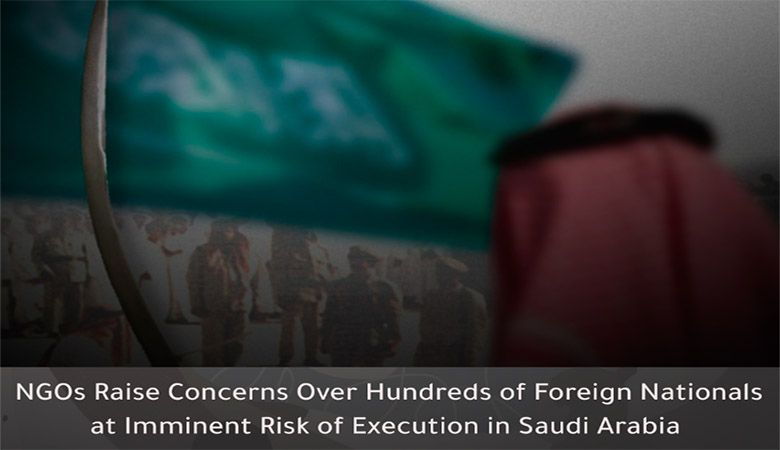
We, the undersigned organizations, express our deep concern for the lives of hundreds of prisoners facing imminent execution in Saudi Arabia for non-violent drug-related offenses. Among them are dozens of Egyptians, Ethiopian, and Somali nationals. These men live in a state of fear amidst a sharp escalation in the issuance and implementation of death sentences for such offenses in recent months. According to official data from the Saudi Press Agency, at least 98 men have already been executed for drug-related crimes in 2025.
At least 37 Ethiopian nationals and 27 Somali nationals—all men—are currently held in Najran Prison in southwestern Saudi Arabia and face death sentences for drug-related offenses. The executions of 19 Somalis and 7 Ethiopians have already been reported since the beginning of the year, all convicted of “hashish trafficking.” In June alone, 12 Somali nationals were executed, in addition to three Ethiopians on 16 June. The remaining detainees continue to live in constant fear that their executions may be carried out at any moment. It is believed that hundreds more are held in the same prison awaiting sentencing, with many having spent years in detention.
Similarly, at least 26 Egyptian nationals, all men, are imprisoned in Tabuk in northwestern Saudi Arabia, facing death sentences for drug-related offenses. At least three Egyptians have already been executed this year on similar charges, including Mahmoud Mohamed Khamees and Farhat Abu El-Saud, who were executed on 24 and 25 May, respectively. Several other detainees have reportedly been informed that their executions will take place after Eid al-Adha, which ended on 10 June.
The UN Special Rapporteur on extrajudicial, summary or arbitrary executions has called on the Saudi authorities to immediately halt these executions and abolish the death penalty in drug-related cases. In his statement, he affirmed: “Any violations of fair trial guarantees that result in the imposition of the death penalty render the sentence arbitrary and unlawful.”
Reports indicate that some of the Egyptian, Ethiopian, and Somali nationals currently on death row for drug offenses may be victims of human trafficking, having been coerced or deceived into transporting illegal substances under threat or false promises. Nevertheless, most were not given a meaningful opportunity to defend themselves in court.
Despite the lack of transparency in Saudi Arabia’s judicial system, human rights organizations with access to court documents and direct testimonies have identified a systematic pattern of abuse during arrest, detention, and trial proceedings. These violations include denial of consular assistance and legal representation, the inability to present an adequate legal defense or appeal and limited or no access to court documentation or effective legal counsel.
Moreover, defendants are frequently subjected to torture or ill-treatment during interrogation and throughout their detention, with courts heavily relying on “confessions” extracted under duress. These practices not only violate Saudi domestic law but also breach the Kingdom’s obligations under the Universal Declaration of Human Rights and the Arab Charter on Human Rights.
It is also worth noting that the cruelty of capital punishment in Saudi Arabia extends beyond the act of execution itself. Families of those executed are often denied the chance to say goodbye or even to know when the sentence will be carried out—frequently learning of the execution through media reports. Authorities typically do not return the bodies of executed individuals nor disclose the burial location, compounding the cruelty and trauma.
The families of prisoners on death row now live in intense fear that executions may be carried out at any moment, amid a shocking rise in executions in the Kingdom. The official Saudi Press Agency reported that as of 17 June 2025, 154 executions had been carried out this year alone—an increase of more than 80% compared to the same period in 2024. That year had already recorded the highest number of executions in the Kingdom’s history, with a total of 345.
Of these 154 individuals, 98 were executed for drug-related offenses, all based on ta’zir (discretionary) rulings. Among them were 69 foreign nationals from 11 Asian and African countries, including: Somalia (19), Pakistan (12), Ethiopia (7), Jordan (6), Iran (6), Afghanistan (5), Syria (5), Nigeria (4), Egypt (3), Sudan (1), and India (1).
Between 2010 and 2021, Saudi Arabia executed nearly three times as many foreign nationals as Saudi citizens for drug-related offenses. Since 2018, the UN Committee on the Elimination of Racial Discrimination has expressed concern over the disproportionate number of foreign nationals sentenced to death in Saudi Arabia.
Executing individuals for non-lethal drug offenses is a blatant violation of international human rights law, which prohibits the use of the death penalty for crimes that do not meet the threshold of the “most serious crimes”—a standard limited to intentional killing. While Saudi Arabia announced a temporary halt on executions for drug offenses from January 2021 to November 2022, this pause was not formalized or made permanent.
Saudi Arabia has long ranked among the top countries in the world for the number of executions. Despite Crown Prince Mohammed bin Salman’s 2018 pledge to limit the use of the death penalty, executions have continued to rise significantly, apart from a brief lull during the COVID-19 pandemic. Even in March 2022, the Crown Prince reiterated his commitment to restricting executions to intentional murder cases. However, the following years saw record-high execution rates—many for non-lethal offenses. Given the lack of transparency and the practice of conducting some executions in secret, the actual numbers may be higher than officially reported. For example, in 2022, 49 out of 196 executions were not announced via the official Saudi Press Agency.
Considering the alarming scale of executions in Saudi Arabia, and the widespread fear among those on death row for drug offenses, we, the undersigned organizations, urge the Saudi authorities to:
- Commute all death sentences issued for offenses that do not meet the threshold of the “most serious crimes” as defined under international law.
- Declare an official moratorium on executions as a step toward the full abolition of the death penalty.
- And until such abolition is achieved, remove all legal provisions that permit the death penalty for offenses not meeting the “most serious crimes” standard, in line with Saudi Arabia’s obligations under international human rights law.