


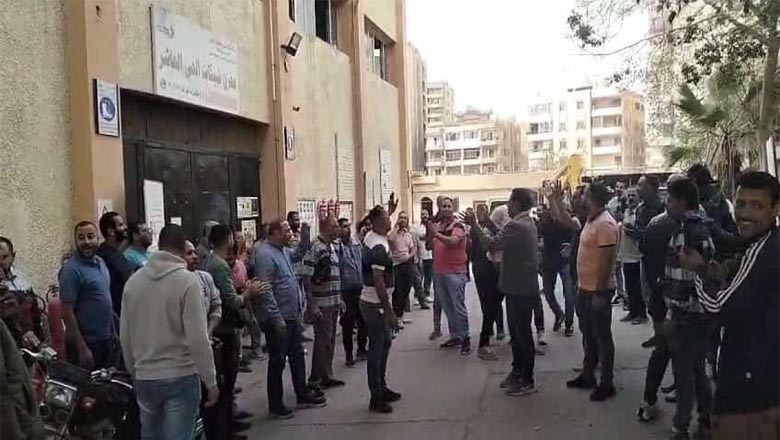
The Egyptian Commission for Rights and Freedoms (ECRF) is closely monitoring the ongoing strike by workers at the Cairo Drinking Water Company, which has now entered its fourth consecutive day. The workers are demanding permanent employment status, payment of outstanding financial entitlements, and improved wages. The strike comes just one day after the Commission documented a complaint filed by 120 meter readers and collectors at the Qalyubia Water Company, who reported being subjected to pressure and threats of dismissal after refusing to switch to an agency-based employment system.
The simultaneous labor actions across more than one company within the water sector reflect continuing tensions among workers engaged in meter reading and bill collection activities. Over recent years, this category of workers has repeatedly raised concerns regarding wages, job security, and the nature of their employment contracts, despite repeated assurances from company management that working conditions had improved.
According to information documented by the Commission, the workers’ primary demands include permanent employment status, as some have been working for more than nine years without obtaining stable employment conditions. They are also demanding payment of overdue allowances—particularly those dating back to 2016—the implementation of the minimum wage in a manner that considers years of experience and job grade, as well as payment of annual profit-sharing entitlements, tax deduction differentials, and increases in transportation and meal allowances.
Workers reported that the current implementation of the minimum wage has failed to consider career progression and years of service, resulting in a narrowing of wage differentials between long-serving and newly hired employees. They view this as inconsistent with principles of wage fairness and proper recognition of years of service.
The strike follows one day after the Commission documented a complaint submitted by 120 meter readers and collectors at the Qalyubia Water Company. The workers stated that they had been pressured to move to an agency-based employment system and threatened with dismissal on 30 June should they refuse to sign new contracts. The recurring incidents across multiple water companies suggest that the issue extends beyond isolated local disputes and instead reflects broader concerns related to job security, wages, and labor relations management within this vital sector.
These developments also raise questions about the methods used to address legitimate labor demands. While workers in Qalyubia, for example, called for meaningful dialogue regarding their employment conditions, the complaint documented by the Commission indicates that some company officials allegedly resorted to threats of dismissal and the involvement of security authorities rather than seeking to resolve the dispute through negotiation and dialogue. Workers fear that the continuation of such approaches may lead to further tensions and escalation across water companies.
The Commission believes that the recurrence of complaints and labor protests within water companies in Cairo, Qalyubia, and other governorates over a relatively short period points to structural problems relating to wages, job security, and different employment arrangements. These issues require a serious review of labor management policies within this essential sector upon which millions of citizens depend.
The Commission also notes that the prolonged delay in the payment of financial entitlements and allowances has a direct impact on the living conditions of workers and their families, particularly amid the continuing rise in living costs and the erosion of the purchasing power of wages. Continued reliance on insecure employment arrangements further increases workers’ vulnerability and undermines guarantees associated with the right to decent work and employment stability.
Accordingly, the Egyptian Commission for Rights and Freedoms calls for the following:
- The immediate opening of a serious dialogue with representatives of the striking workers and genuine engagement with their demands.
- Clear measures to address the issue of permanent employment for workers who have spent many years in service.
- Prompt resolution of outstanding allowances and delayed financial entitlements, and payment of all dues owed to workers.
- Ensuring that the minimum wage is implemented in a manner that reflects experience and career progression and preserves fairness among workers.
- Guaranteeing that no punitive or retaliatory measures are taken against workers for participating in the strike or claiming their legitimate rights.
- Reviewing the conditions of temporary workers and unstable employment arrangements within water companies and other state-affiliated entities to ensure compliance with decent work standards and employment stability.
For legal support or to document any violation, please contact the Egyptian Commission for Rights and Freedoms’ hotline via WhatsApp at: +20 122 054 9568.