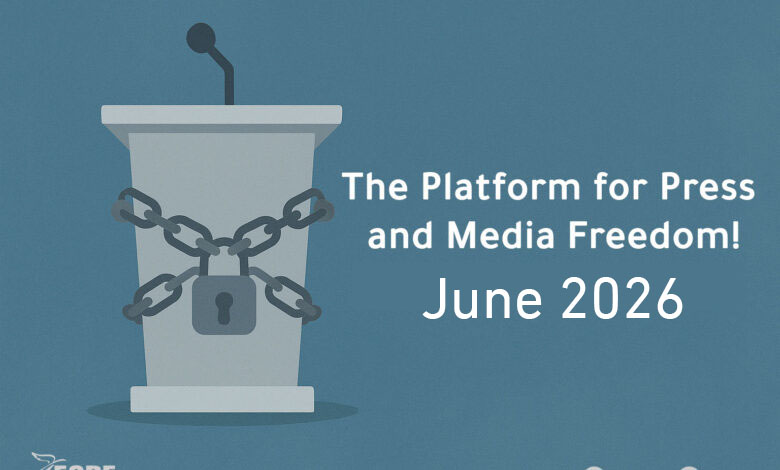
Press and Media Freedom Platform!.. June 2026 Roundup
The Egyptian Commission for Rights and Freedoms (ECRF) launches its bulletin on violations against the press, media professionals, and those working in the journalism and media sector, as well as restrictions imposed on media outlets. In this bulletin, the Commission documents the most prominent violations witnessed within the journalistic and media community throughout June 2026 and the restrictions faced by those working in the field.
The continued detention of journalists and opinion holders constitutes a clear constitutional violation of Article 71 of the Egyptian Constitution, which prohibits custodial penalties in publication and publicity-related cases.
However, local and international human rights experts have documented the Egyptian authorities’ use of broadly worded legal provisions, such as charges of “spreading false news” and “misusing social media,” as a tool to justify prolonged pretrial detention. This pattern is used to circumvent the limits of judicial conviction, resulting in ongoing arbitrary detention that exceeds the legal maximum through a practice known as “rotation” (tadweer).
Articles 80(d) and 188 of the Egyptian Penal Code are among the provisions most frequently used in this context, as they criminalize the dissemination of news or statements deemed likely to disturb public order or undermine confidence in the state.
Article 76 of the Telecommunications Regulation Law is also used to accuse individuals of misusing social media platforms.
The Anti-Cyber and Information Technology Crimes Law (Law No. 175 of 2018) is used in “misuse of social media” cases by treating personal accounts as public spaces subject to criminal liability when content published or shared on them is considered unlawful by investigative authorities.
Article 19 of the Law Regulating the Supreme Council for Media Regulation prohibits newspapers, media outlets, and websites from publishing or broadcasting false news. This prohibition also extends to personal websites, blogs, and social media accounts.
Meanwhile, Article 35 of the Anti-Terrorism Law is used to bring charges related to disseminating inaccurate information that undermines public confidence or harms national interests.
The following are the most significant violations of press and media freedoms documented by the Egyptian Commission for Rights and Freedoms during June 2026:
Detention Renewal Decisions
On 8 June 2026, the Advisory Chamber convened at the Badr Prison Courts Complex ordered the renewal of the detention of researcher and investigative journalist Ismail Alexandrani for 45 days pending investigations in Case No. 6469 of 2025 (Supreme State Security).
On 24 September 2025, researcher and investigative journalist Ismail Alexandrani was stopped at a security checkpoint near the city of Marsa Matrouh. The Supreme State Security Prosecution subsequently ordered his detention for fifteen days pending investigations in Case No. 6469 of 2025 (Supreme State Security). The prosecution’s decision came after long hours of interrogation, during which he faced accusations of “spreading false news, joining a terrorist group, and using a website to promote ideas advocating terrorist acts.”
It is worth noting that Ismail Alexandrani was released from prison in December 2022 after spending seven years behind bars. His case dates to November 2015, when he was arrested at Hurghada Airport upon returning from a conference held in Berlin, Germany.
At the time, the Supreme State Security Prosecution charged him with membership in a terrorist group and spreading false news. Although a criminal court ordered his release after one year of pretrial detention, the prosecution appealed the decision, resulting in the continuation of his detention. In December 2017, his case was referred to military judiciary, which sentenced him to ten years in prison in May 2018. The sentence was later reduced to seven years in October 2022, and he was released two months after the reduction.
On 15 June 2026, the First Terrorism Circuit of the Cairo Criminal Court, convened at the court complex attached to the Badr Correction and Rehabilitation Center, postponed the sixth hearing in the trial of Shababikwebsite journalist Medhat Ramadan in Case No. 680 of 2020 (Supreme State Security), registered as Felony No. 557 of 2025 (First El Salam Felony Court), to 18 October 2026 for the defense pleadings.
The journalist was arrested from his family home in Monufia Governorate on 28 May 2020 and remained forcibly disappeared for one month until he appeared before the Supreme State Security Prosecution on 27 June 2020. He was investigated in Case No. 680 of 2020 (Supreme State Security) and faced charges of joining a terrorist group, spreading false news and statements, and misusing social media. He was subsequently placed in pretrial detention pending the case.
On 21 June 2026, the Second Terrorism Circuit of the Cairo Criminal Court postponed the fourth hearing in the trial of photojournalist Hamdy El-Zaeem to 27 September 2026 for the prosecution’s closing arguments.
According to the referral order in Case No. 955 of 2020 (Supreme State Security), registered as Case No. 29 of 2025 (Fifth Settlement Felonies), El-Zaeem faces charges of joining a terrorist group with knowledge of its objectives and participating in a criminal agreement aimed at committing terrorist acts.
Security forces had arrested El-Zaeem on 5 January 2021 after stopping him while he was complying with the precautionary measures imposed on him in his previous case. He was taken to an undisclosed location for 12 days before appearing before the prosecution and being detained pending investigations in Case No. 955 of 2020 (Supreme State Security).
According to Mirna El-Zaeem, the photojournalist’s daughter, her father suffered a stroke in prison that affected his leg. He also suffers from diabetes and hypertension and has poor eyesight. She called on the authorities to release him, noting that he is the family’s sole breadwinner.
It is worth noting that Hamdy El-Zaeem was arrested on 26 September 2016 on the steps of the Journalists Syndicate and later appeared in connection with Case No. 15060 of 2016 (Qasr El-Nil Misdemeanors). He remained in pretrial detention until his release on 13 June 2018 under precautionary measures, which he continued to comply with until he was arrested again.
Decisions of the Supreme Council for Media Regulation
On 3 June 2026, the Supreme Council for Media Regulation, headed by Engineer Khaled Abdel Aziz, received a complaint from Mr. Wael Nabih, Managing Director and legal representative of the Al-Masry for Journalism, Printing, Publishing, Advertising, and Distribution Foundation, the publisher of Al-Masry Al-Youm newspaper, against the Cairo 24 website, alleging infringement of the newspaper’s intellectual property rights.
In its complaint, the foundation stated that Cairo 24 had published a photograph originally belonging to Al-Masry Al-Youm depicting citizens gathered in front of one of the branches of a bank on 25 May 2026. The foundation added that the photograph had been taken by a photojournalist working for Al-Masry Al-Youm and had been published by the newspaper nine hours earlier. It further noted that Cairo 24 had published the image without indicating that it had been sourced from the newspaper.
The complaint was referred to the Complaints Committee, chaired by media figure Essam El-Amir, Deputy Chairman of the Council, for examination and review and for any necessary action in accordance with the provisions of the Press and Media Regulation Law No. 180 of 2018 and its implementing regulations.
On 4 June 2026, the Supreme Council for Media Regulation, headed by Engineer Khaled Abdel Aziz, decided to dismiss the complaint submitted by the Al-Masry for Journalism and Printing Foundation, owner of Al-Masry Al-Youm newspaper, against the Cairo 24 website and to halt all procedures arising from it. The decision came considering an official request submitted by the foundation to withdraw the complaint, in a spirit of professional collegiality, support for solidarity within the journalistic community, and in response to the initiative and efforts of the President of the Journalists Syndicate.
The Council had previously received a complaint from the legal representative of the Al-Masry for Journalism, Printing, Publishing, Advertising, and Distribution Foundation, publisher of Al-Masry Al-Youm, against Cairo 24on the grounds of infringing the newspaper’s intellectual property rights.
The Supreme Council for Media Regulation reaffirmed its commitment to protecting intellectual property rights in the fields of journalism and media and to ensuring that media outlets and journalistic institutions respect intellectual and literary property rights. According to the Council, this contributes to supporting press institutions, preserving the sustainability of professional media, and achieving a balance between safeguarding legal and moral rights and ensuring responsible press freedom, in accordance with Law No. 180 of 2018.
On 7 June 2026, the Supreme Council for Media Regulation, headed by Engineer Khaled Abdel Aziz, issued a set of regulatory decisions concerning medical content circulated through media outlets and social media platforms under the name of Mennatallah Mohsen Abdel Moneim, within the framework of the powers granted to the Council under Law No. 180 of 2018.
In an official statement, the Council explained that these measures were taken out of concern for protecting public health and safeguarding citizens and patients from inaccurate medical information or advice that contradicts established scientific standards.
The statement noted that the decision followed the Council’s receipt of an official letter from the Ministry of Health and Population documenting the dissemination of unverified medical information and the provision of treatment advice without recognized scientific or professional qualifications. The letter also referred to the promotion of treatment methods not recognized by medical authorities and inconsistent with approved medical protocols, which could mislead public opinion through conclusions lacking a scientific basis.
The Council also relied on a letter from the Doctors Syndicate, which confirmed that the individual concerned was not registered with the Syndicate and was not authorized to practice medicine.
The Council’s decisions included four main measures:
-Requiring all media outlets subject to the provisions of Law No. 180 of 2018 to prevent the appearance of Mennatallah Mohsen Abdel Moneim across all media platforms.
-Blocking social media accounts bearing her name and requiring media outlets, newspapers, digital platforms, websites, and social media accounts not to broadcast, publish, republish, or circulate any visual, audio, or written content issued by her.
-Assigning the Council’s General Monitoring Department to continuously and accurately monitor the implementation of the decision and document any violations to take the necessary legal measures.
-Notifying the National Telecommunications Regulatory Authority of all links and platforms that had published the prohibited content so that urgent technical measures could be taken to halt its circulation and remove it from websites and social media pages.
At the conclusion of its statement, the Supreme Council for Media Regulation called on all social media users to comply with the decision and refrain from republishing or circulating the content in question, in support of the public interest and for the protection of public health and citizens’ safety.
On 11 June 2026, the Supreme Council for Media Regulation, headed by Engineer Khaled Abdel Aziz, decided to summon the legal representative of Al-Shams TV channel to a hearing regarding content included in the episode of the program Al-Basmah, broadcast on 10 June and presented by Mohamed El-Gheiti on Al-Shams TV, because it violated the privacy of the late actor Abdel Aziz Makhyoun.
The Council also ordered the channel to remove the episode from social media platforms pending the completion of the investigation into the complaint.
The Council had received a complaint from Dr. Ashraf Zaki, President of the Actors Syndicate, requesting an investigation into the violations allegedly committed during the episode.
On 11 June 2026, the Supreme Council for Media Regulation, headed by Engineer Khaled Abdel Aziz, received a complaint from Member of Parliament Hassan Tarek Ammar against Ahmed Shobier concerning remarks he made while presenting the programs Hona Al-Mondial, broadcast on Al-Nahar TV on 10 June, and Ma‘a Shobier, broadcast on ON Sport Radio on 11 June, because the remarks were offensive to supporters of Al-Masry Sporting Club of Port Said.
The complaint was referred to both the Complaints Committee, chaired by Essam El-Amir, Deputy Chairman of the Council, and the Sports Media Performance Regulation Committee, chaired by Counselor Abdel Salam El-Naggar, a Council member and Deputy President of the State Council, for examination and review and for any necessary action in accordance with the Press and Media Regulation Law No. 180 of 2018 and its implementing regulations.
On 13 June 2026, the Complaints Committee of the Supreme Council for Media Regulation, chaired by Essam El-Amir, Deputy Chairman of the Council, in coordination with the Sports Media Performance Regulation Committee, chaired by Council member Counselor Abdel Salam El-Naggar, decided to summon the legal representative of Al-Nahar TV channel and the administrator of the Facebook account operating under the name Ahmed Shobier.
The committee stated that they had been summoned to a hearing concerning complaints submitted to the Supreme Council for Media Regulation against Ahmed Shobier by several Members of Parliament representing Port Said Governorate over remarks he made during the television program Hona Al-Mondial on Al-Nahar TV on 10 June and in a video published through his social media account on 11 June.
On 16 June 2026, the Supreme Council for Media Regulation, headed by Engineer Khaled Abdel Aziz, approved the recommendations of the Complaints Committee, chaired by Essam El-Amir, Deputy Chairman of the Council, requiring all media outlets subject to the Press and Media Regulation Law No. 180 of 2018 to prevent the appearance of Mohamed El-Gheiti, host of the program Al-Basmah on Al-Shams TV, for a period of one month.
The decision was issued in response to the content of the episode broadcast on 10 June, which the Council considered to have violated the privacy of the distinguished late actor Abdel Aziz Makhyoun.
The decision was based on a report prepared by the Council’s General Monitoring Department, which concluded that the episode contained violations of the provisions of Law No. 180 of 2018, as well as on the hearing held on Monday, 15 June, in the presence of the legal representative of Al-Shams TV channel.
On 30 June 2026, the Media and Youth Committee of the Supreme Council for Media Regulation held an extensive community dialogue session that brought together more than 30 specialists in the fields of media, law, legislation, psychology, sociology, and technology to discuss guidelines governing how media outlets and social media platforms cover incidents involving children, whether as offenders, victims, or witnesses.
The session featured a comprehensive review of the current state of media coverage of children in contact with the law and the challenges associated with such coverage. It also included a presentation of international experiences in this field by Dr. Abdel Basir Hassan, journalist and Senior Correspondent at BBC Arabic, who recently earned a PhD with highest honors from the Faculty of Mass Communication at Cairo University for his dissertation entitled: “Television Coverage of Legal Conflicts in Light of the Child’s Right to Privacy.”
The session also included extensive interventions and discussions involving Counselor Hisham Jaafar, President of the Court of Appeal and Head of the Child Rights Protection Office at the Public Prosecutor’s Office; Dr. Adel Abdel Ghaffar, Professor of Media at Cairo University; Dr. Samia Desouki; Dr. Alia Abu Douma, Professor of Media Sociology at the Faculty of Women, Ain Shams University; Dr. Laila Abdel Meguid, Professor of Media Legislation at Cairo University; Dr. Reda Amin, Dean of the Faculty of Mass Communication at Al-Azhar University; and Maged Mounir, Editor-in-Chief of Al-Ahram. Participants emphasized the importance of achieving a balance between society’s right to know and the child’s right to privacy and protection, while stressing the need for a professional and ethical framework governing media coverage related to children.
A number of participants, including Hanaa El-Semary, Deputy Head of the News Sector at Maspero; Manal El-Daftar, Head of Channel One at Egyptian Television; Lamia Samir, Head of the Egyptian Satellite Channel; Awatef Abu El-Soud, Deputy Head of Channel Two at Egyptian Television; Mohamed Donia; journalist and writer Mahmoud El-Shenawy, representative of the Middle East News Agency; and Dr. Khaled Saad, presented a range of proposals aimed at regulating media practices across both traditional media and digital platforms.
The session concluded with the adoption of a preliminary draft Code of Conduct for the Protection of the Privacy of Children in Contact with the Law. The draft included a number of principles and guidelines, foremost among them respect for society’s right to know while guaranteeing the child’s right to privacy and protection, as well as establishing clear standards for covering children’s issues in the media.
Among the key recommendations were limiting the appearance of children on television channels and digital platforms and ensuring that they are only shown when necessary, while re-editing published materials in ways that protect their identities. The recommendations also called for utilizing artificial intelligence technologies to conceal children’s facial features in footage or interviews that could infringe upon their rights, in addition to safeguarding a child’s right to have their photographs and videos removed from digital platforms.
The session further recommended activating existing legal and media tools, introducing legislation that keeps pace with digital developments, and coordinating with the Ministry of Communications and Information Technology and the National Telecommunications Regulatory Authority to take the necessary measures against pages and platforms that violate the Code of Conduct. It also called for coordination with the Ministry of Education to enhance children’s awareness of their rights and how to protect themselves in media environments.
Participants emphasized the importance of training journalists and media professionals on standards for the professional coverage of children’s issues, adopting internal codes of conduct within media and journalistic institutions, and establishing a hotline through which children can contact the relevant authorities to report any violations involving the use of their images or personal data by media outlets or social media platforms.
The Code also included a clear definition of what constitutes a violation of the privacy of a child in contact with the law, as well as the responsibilities of media professionals and influencers. These responsibilities include adhering to the best interests of the child, obtaining informed consent, complying with guidelines governing interviews and media coverage, observing standards for preparing visual and audiovisual materials and for broadcasting and publication, and promoting professional accountability, continuous training, and coordination with the relevant authorities.
At the conclusion of the session, participants stressed that this dialogue represents a starting point for a broader national discussion on protecting children within the media and digital environment. They emphasized that the issue extends beyond the professional sphere to become a matter of national and societal security, requiring the combined efforts of state institutions, civil society organizations, and the private sector.
On 30 June 2026, the Supreme Council for Media Regulation, headed by Engineer Khaled Abdel Aziz, received a complaint from lawyer Ashraf Abdel Aziz, legal representative of Hossam Hassan, head coach of the Egyptian national football team, against poet, writer, and screenwriter Medhat El-Adl.
In his complaint, Hossam Hassan’s representative stated that he was surprised to find the respondent posting comments through his verified personal Facebook account on one of the platform’s pages using language that, in his view, contained offensive remarks directed at the head coach of the Egyptian national team.
The complaint was referred to the Complaints Committee, chaired by media figure Essam El-Amir, Deputy Chairman of the Council, which decided to summon the administrator of the verified Facebook account under the name “Medhat El-Adl” to initiate the review and hearing procedures conducted by the committee in order to examine the complaint, determine its circumstances and implications, and take any necessary measures in accordance with the provisions of the Press and Media Regulation Law No. 180 of 2018 and its implementing regulations.
The Complaints Committee also decided to summon the administrators of several other social media accounts for violations of media codes and standards. It decided to summon the administrator of the account operating under the name “Mohamed El-Sabbagh” for publishing inaccurate claims regarding the legendary singer Umm Kulthum.
The committee further decided to summon the administrator of the account named “Hossam Gamal” for using inappropriate language and for insulting a number of public figures, including media personalities and football players. It also decided to summon the administrator of the page “Al-Murad Al-Manshoud” for promoting inaccurate medical information and unsubstantiated scientific opinions in violation of the applicable media regulations and standards.
Decisions of the Media Professionals Syndicate
On 10 June 2026, Dr. Tarek Saada, President of the Media Professionals Syndicate, issued a decision to close the investigation involving media presenter Reham Saeed following her appearance before the Syndicate’s Investigation Committee at its headquarters.
The investigation was initiated based on a report prepared by the Syndicate’s Media Observatory, in addition to a complaint submitted by one of the guests who appeared on an episode of the program Sabaya Al-Kheir, broadcast on Al-Nahar TV on 21 May 2026, which addressed the issue of stray dogs.
During the investigation, Reham Saeed presented her defense, affirming her commitment to presenting different viewpoints related to the issue, providing both sides of the debate, and outlining the legal approaches available for addressing the matter under discussion.
She explained that differences of opinion regarding societal issues are natural and that discussing such topics, along with the presentation of various perspectives and proposed solutions, primarily serves the public interest and the interests of society by enabling viewers to examine different viewpoints and form their own opinions freely.
At the conclusion of his statement, the President of the Media Professionals Syndicate stressed the necessity for all media professionals to adhere to professional standards and impartiality when addressing various issues. He emphasized the importance of presenting all viewpoints without favoring one opinion over another or steering discussions either for or against the views of guests.
He further explained that this approach is consistent with the Media Code of Ethics and the Professional Code of Conduct and helps ensure the delivery of a professional and balanced media message to Egyptian and Arab audiences.
On 11 June 2026, Dr. Ashraf Zaki, President of the Actors Syndicate, submitted an official complaint to Dr. Tarek Saada, President of the Media Professionals Syndicate, against Mohamed El-Gheiti, host of the program Al-Basmah, over his discussion of certain matters concerning the late actor Abdel Aziz Makhyoun that, according to the complaint, should not have been disclosed.
Based on the complaint, Dr. Tarek Saada issued a decision summoning El-Gheiti and referring him for investigation.
The Media Professionals Syndicate also called on all its members across its five professional divisions—preparation, presentation, directing, editing, and media correspondence—to adhere to the Media Code of Ethics and the Professional Code of Conduct.
On 17 June 2026, Tarek Saada, President of the Media Professionals Syndicate, announced that the Syndicate would hold its first election to choose its first elected governing council since its establishment. He stated that the Syndicate Council had convened that day to finalize all arrangements and procedures related to the electoral process, describing the step as a historic milestone in the Syndicate’s journey and the beginning of a new phase based on the will of media professionals and their choice of representatives.
Saada stated that the Media Professionals Syndicate was established in 2016 after years of demands for a professional body representing workers in the media sector. He noted that these demands did not receive a response until the presidency of Abdel Fattah El-Sisi, to whom he expressed gratitude for supporting the establishment of the Syndicate and helping bring it into existence.
He added that the next step came through a decision by the Council of Ministers to form a founding council for the Syndicate, composed of eleven experienced media professionals. He explained that the founding council received continuous support from the Cabinet throughout the various stages of establishing the Syndicate.
The President of the Syndicate indicated that the organization faced numerous challenges and difficulties during its founding phase, including issues related to securing headquarters, membership registration procedures, and institutional organization. He stated, however, that these obstacles were overcome, resulting in the creation of a professional body capable of fulfilling its role. He remarked: “We succeed, and we make mistakes; we disagree, and we agree, but the higher interests of the nation and the profession remain the objective that unites us all.”
He stressed that the Syndicate has become an institution that brings together the Egyptian media community and serves as a home for all media professionals, while expressing appreciation to the Council of Ministers for its support over the years.
Saada also praised the role played by Diaa Rashwan, Minister of State for Information, stating that he closely followed the Syndicate’s work and was keen to ensure that the Media Professionals Syndicate became a fully established legal entity capable of keeping pace with developments in digital media.
He explained that the Syndicate had succeeded in establishing an observatory to combat rumors and had also played an important role in confronting impersonators and fictitious entities claiming to operate in the media sector. He pointed to cooperation with the Civil Status Authority to ensure that the designation “media professional” cannot be recorded on a national identity card unless the individual has obtained the Syndicate’s officially approved certification and seal.
He added that the Syndicate had achieved significant progress in the areas of social insurance and pensions, explaining that no person working in the media sector would be entitled to receive a pension as a media professional without obtaining official accreditation and the Syndicate’s seal, thereby helping regulate the profession and protect the rights of those working in it.
Saada further noted that cooperation among media professionals over the past years had been substantial and constructive and had contributed to numerous achievements despite limited available resources. He stated that the Syndicate possesses a surplus of housing units, including both vacation properties and permanent residences, in addition to organizing Hajj and Umrah trips and implementing a healthcare project for members. He emphasized that all these accomplishments had been achieved “with zero resources” and through the determination of those working in the profession.
The President of the Syndicate affirmed that opening the door to elections reflects the full desire of media professionals themselves to elect a new council that will mark the beginning of a permanent phase of institutional trade union work, enabling the rotation of responsibilities and the existence of elected councils that reflect the will of Syndicate members in the future.
He stated that the Syndicate Council had exerted “extraordinary efforts” to reach this important stage and affirmed that the council possesses a distinguished record in handling all legal and professional matters and decisions adopted throughout the past years. He further asserted that no legal deficiencies had been identified in any decision issued by the council.
Saada stressed that the interests of the state and the interests of media professionals have always remained among the council’s foremost priorities, alongside its continuous efforts to develop the media profession and improve the conditions of media workers. He added that the Syndicate has never ceased fulfilling its social responsibilities in the areas of education, public enlightenment, and awareness-raising.
In concluding his remarks, the President of the Media Professionals Syndicate emphasized that the challenges facing Egyptian society place significant responsibilities on the media. He noted that media professionals possess the capabilities necessary to formulate a simple and effective media message capable of reaching all segments of Egyptian society. He added that the past ten years have represented a defining period in the Syndicate’s history, marked by numerous major challenges and critical moments that could only be overcome through prudent management and sound judgment that take social considerations into account, safeguard the interests of the state, and adhere fully to the law.