Statement on the Security Campaign Against Refugees and Asylum Seekers in Egypt and Demands to Halt Targeting and Forced Deportations
Feb 28, 2026
.
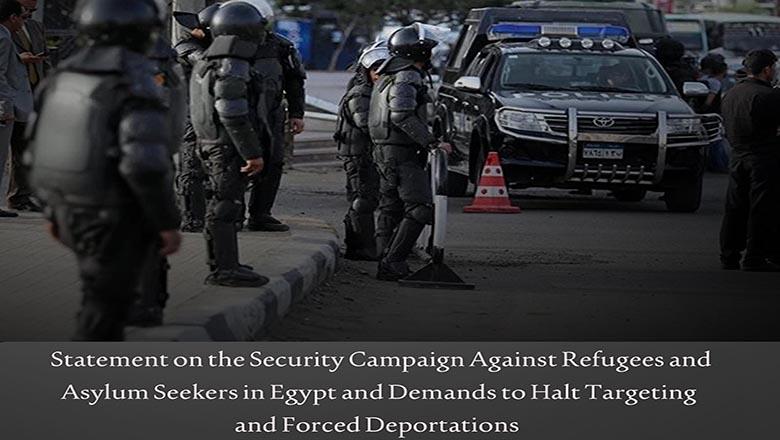
The Egyptian Commission for Rights and Freedoms expresses its profound concern and condemnation of the wide-scale security campaign targeting refugees and asylum seekers in Egypt since December 2025 to date. This campaign has been accompanied by mass arrests, administrative detention, and forced deportation procedures lacking the requisite legal safeguards, in violation of the Egyptian Constitution, national laws, and the international obligations undertaken by the State, as well as contrary to fundamental legal and humanitarian principles.
The principle of non-refoulement constitutes the cornerstone of refugee protection. It is firmly established in Article (33) of the 1951 Convention Relating to the Status of Refugees, to which Egypt is a party, and prohibits the expulsion or return of any refugee to the frontiers of territories where their life or freedom would be threatened or where they may face persecution.
Article (3) of the Convention Against Torture further prohibits the transfer of any person to a State where there are substantial grounds for believing that they would be in danger of being subjected to torture. Moreover, Article (93) of the Egyptian Constitution affirms the State’s commitment to international human rights conventions and covenants it has ratified, granting them the force of law. The Constitution also prohibits arbitrary arrest and detention and guarantees the right to challenge decisions restricting personal liberty. In addition, the rules regulating the entry and residence of foreigners — including Law No. 164 of 1960 concerning passports and related regulations — do not permit deportation measures in violation of constitutional safeguards or without enabling the individual to exercise their right to defense and appeal.
Holders of registration cards issued by the United Nations High Commissioner for Refugees are presumed to benefit from international protection. They may not be forcibly deported or detained for the purpose of removal without being enabled to communicate with UNHCR and their lawyers, and without access to an effective legal avenue to challenge such decisions.
Documented and recurring incidents indicate numerous and serious humanitarian violations, including inhumane detention conditions that fail to respect human dignity; preventing detainees from communicating with their families or lawyers; confiscation of asylum cards and passports without legal basis; coercing certain detainees into signing “voluntary return” forms; disregard for critical health conditions, including advanced pregnancy, post-surgical patients, and elderly persons; and the absence of an effective legal mechanism to challenge deportation decisions.
The Egyptian Commission for Rights and Freedoms highlights several cases it has documented in which individuals were subjected to violations, including (A.M.N.A.), a Sudanese national registered with UNHCR, who was arrested on 7/2/2026 after leaving a mosque and detained at First Al-Obour Police Station. Despite the issuance of a decision for his administrative release, deportation procedures proceeded, and his UNHCR card and passport were confiscated. On 21/2/2026, he was transferred to Banha Deportation Department in preparation for his transfer to the Qastal border crossing, without enabling his family to effectively challenge the decision, despite his advanced age and serious concerns for his life.
Also (N.A.H.Y.), a Sudanese woman in her eighth month of pregnancy, was detained on 9/2/2026 after being arrested from her home in Shebin El-Qanater. Her husband was released due to the legality of his residency, while deportation procedures against her continued despite her critical health condition and without the provision of adequate medical care, constituting a flagrant violation of humanitarian standards for the protection of pregnant women.
Another case involves (A.D.A.M.), a refugee who had undergone arm surgery and was arrested on 31/12/2025. Despite a decision ordering his release, his health deteriorated in detention, and the surgical procedure failed due to medical negligence and ill-treatment. A decision was issued to transfer him to a hospital but was not effectively enforced, until he was later released following the severe deterioration of his health condition.
The Egyptian Commission reiterates its demands as follows:
Calling on the European Union to review its designation of Egypt as a “safe country” for asylum seekers in light of recent developments.
The immediate cessation of arbitrary arrests and forced deportations, and an end to coercing refugees into signing “voluntary return” forms.
Urging UNHCR to adopt a clear and public position regarding the ongoing violations and to take urgent protective measures for those registered with it.
Excluding security bodies not competent in asylum matters from managing or overseeing refugee affairs.
Opening independent investigations by the Public Prosecution into cases of death or medical negligence within places of detention.
Reassessing grants and funding allocated to migration and asylum management pending policy reforms consistent with international law.
Calling upon the United Nations Special Rapporteur on the human rights of migrants and refugees to conduct an urgent visit to Egypt to examine the current crisis.
In conclusion, the Egyptian Commission unequivocally affirms that the current policies will not lead to sustainable solutions; rather, they may drive more refugees toward dangerous irregular migration routes, thereby exacerbating the crisis regionally and internationally. Respect for the rule of law, adherence to international standards, and the guarantee of humane and dignified treatment are not optional commitments, but legal and ethical obligations incumbent upon the State.