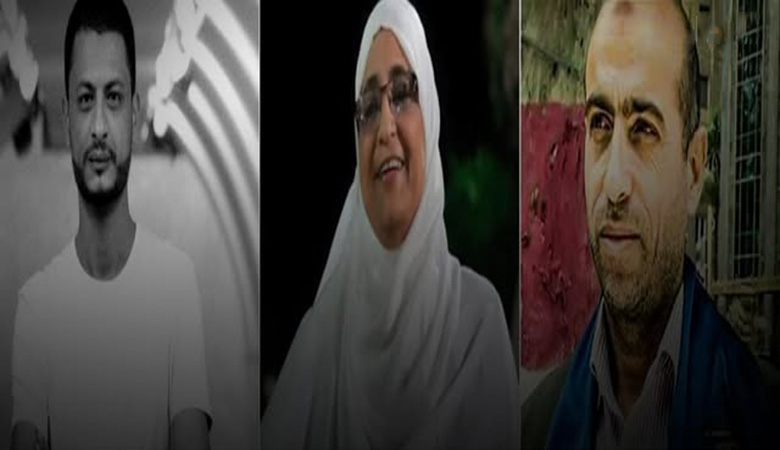
UN Human Rights Office calls for the release of political prisoners, including poet Galal El-Behairy, lawyer Ibrahim Metwally, and human rights defender Hoda Abdel Moneim
The statement urges the Egyptian authorities to immediately end the continued arbitrary and prolonged detention of political opponents and to secure their immediate release, along with all other detainees.
August 26, 2025
.
The Office of the United Nations High Commissioner for Human Rights (OHCHR) called on the Egyptian authorities to put an end to the arbitrary and prolonged detention of political opponents and government critics, including after they have served their sentences or completed the maximum period of pretrial detention. This came in a statement issued by the UN High Commissioner for Human Rights on Tuesday, 26 August 2025, demanding the release of all detainees who have exceeded the legal limit of pretrial detention.
The statement referred to poet Galal El-Behairy, who was arrested on 3 March 2018 at Cairo Airport following a complaint accusing him of insulting the President of the Republic. In July 2018, a military court sentenced him to three years in prison with hard labor and a fine of 10,000 EGP, over a poetry collection deemed offensive to the military institution and its leadership. On 31 July 2021, El-Behairy completed his sentence in Case No. 4 of 2018 (Military Prosecution Misdemeanors), yet he remained detained at Kafr Shukr Police Station for about 10 days, before being transferred to the National Security headquarters in Benha. He reappeared on 5 September 2021, charged in Case No. 2000 of 2021—his third case since his initial arrest in March 2018.
The statement also referred to similar practices against Alaa Abdel Fattah, as well as lawyer and former member of the National Council for Human Rights Hoda Abdel Moneim, and human rights lawyer and founder of the Association of the Families of the Disappeared Ibrahim Metwally Hegazy, all of whom remain in detention.
Lawyer Hoda Abdel Moneim was arrested on 1 November 2018 from her home in Cairo by security forces without a search or arrest warrant. She was subjected to 21 days of enforced disappearance before appearing before the Supreme State Security Prosecution, where she was charged in Case No. 1552 of 2018 (Supreme State Security), known in the media as the “Coordination Case.” The case was referred to the Emergency State Security Criminal Court, which sentenced her to five years of rigorous imprisonment, followed by five years of probation.
She faced charges of joining an unlawful group, promoting its ideas through social media, founding the “Egyptian Coordination for Rights and Freedoms” (a banned entity), providing financial support to members of the Muslim Brotherhood, and publishing reports allegedly containing false information about human rights violations. Abdel Moneim, a 66-year-old lawyer before the Court of Cassation and the Supreme Constitutional Court, has been denied the right to see her daughters and husband due to prison restrictions. She has also been placed on the terrorist entities list for three years by a ruling of the Cairo Criminal Court in October 2022.
Upon completing her five-year sentence, Abdel Moneim was recycled into new cases instead of being released. On 1 November 2023, she was placed in pretrial detention in Case No. 730 of 2020 (Supreme State Security). On 17 November 2024, while still detained, she was charged again in Case No. 800 of 2019 (Supreme State Security), and she remains in pretrial detention.
During her imprisonment, Abdel Moneim suffered from medical neglect, having experienced a heart attack while in Qanater Women’s Prison, which required her transfer to Qasr El-Aini Hospital. During one of her court sessions, she requested a cardiac catheterization and stent placement due to her deteriorating condition, but the necessary treatment was not provided.
The statement also highlighted the case of human rights lawyer Ibrahim Metwally, founder of the Association of the Families of the Disappeared. His first trial session in one of the cases against him was held on 1 June 2025, after more than seven years in pretrial detention, in Case No. 900 of 2017 (Supreme State Security). The court has also set 11 June 2025 for the first hearing in a second case, No. 1470 of 2019 (Supreme State Security).
Metwally was arrested on 10 September 2017 at Cairo Airport while traveling to attend the UN Human Rights Council’s annual meeting to raise the issue of enforced disappearances. He reappeared three days later, accused in Case No. 900 of 2017 of founding and leading an unlawful group, spreading false news, and communicating with foreign parties. On 5 November 2019, he was again charged in Case No. 1470 of 2019, accused of joining a terrorist group and committing terrorist financing crimes. Although the prosecution ordered his release on 26 August 2020, he was subjected to enforced disappearance again before reappearing on 6 September 2020 charged in yet another case.
The High Commissioner described these practices by the Egyptian government as tools used to suppress individuals perceived as critics or opponents of its policies. UN High Commissioner for Human Rights Volker Türk urged the Egyptian authorities to immediately release all those arbitrarily detained for exercising their fundamental freedoms or defending human rights, and to refrain from using legal proceedings—including counterterrorism legislation or other criminal laws—as punishment for the peaceful exercise of fundamental human rights.